Discover the importance of reflective teaching strategies in education and how they can enhance teaching effectiveness and student engagement. Start implementing these strategies today
Reflective teaching is a process in which teachers reflect on their teaching practices, analyze how something was taught and how the practice could be improved or changed for better learning outcomes. Points to consider in the reflection process might be what is currently being done, why it is being done, and how well students are learning. You can use reflection as a way to simply learn more about your own practice, improve a certain practice (small group and cooperative learning, for example), or to focus on a problem students are having. Let us now discuss some reflective teaching methods.
Reflective Teaching Strategies You Must Know As Teacher.
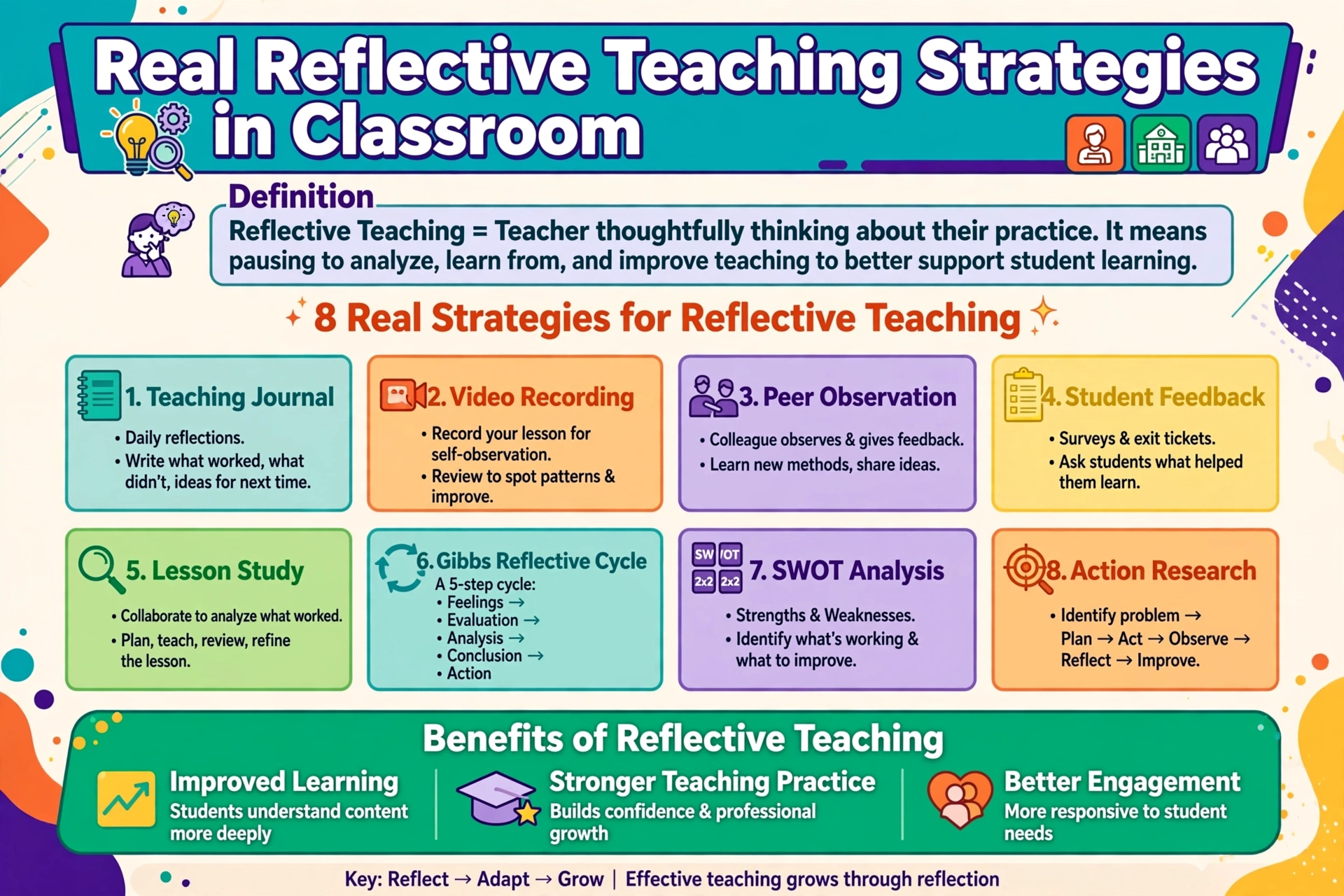
These are practical, low-effort moves that can be immediately implemented.
| Strategy | How it Works | Why it’s Effective |
|---|---|---|
| One-Minute Paper | At the end of class, ask students: “What was the most important thing you learned?” and “What is still unclear?” | Provides rapid, actionable feedback on student comprehension and areas needing clarification. |
| In-Class Polls | Use regular, quick polls (via clickers, apps, or a show of hands) during the lesson. | Offers real-time data to check understanding and adjust instruction during the lesson (reflection-in-action). |
| The “Hinge” Question | Plan one key question that students must answer before moving on. | Serves as a checkpoint to ensure the class is ready to proceed before you introduce more complex material. |
| The “Who?” Framework | After a lesson, ask yourself: Who did all the talking? Who struggled? Who benefitted most? | Encourages a focused reflection on student engagement and individual needs, moving beyond a general sense of how the lesson went. |
keep a diary.
After each class, take some notes on what was taught and how the students responded, positive or negative. Did you understand the material? Do you need more preparation time to teach the lesson effectively? Reflect on this information at the end of the day. Keep a journal , writing down what you could do differently or what worked well.
Get Feedback.
After a lesson or activity or at the end of class, ask students to briefly and honestly describe what they learned and what, if anything, did not work well in the lesson. Let them give their feedback anonymously. Collect the responses and make notes in your journal about your observations to improve or change your teaching practices. You can also ask a colleague whose teaching standards you admire to come into your classroom and observe a session. Ask for honest feedback and let your colleague know that your goal is to improve.
Record your class.
Install a camera to record videos or record your class. Listen or watch it all later that day and write down everything that works well and what doesn’t for your students. Are you only involving one or two students and not trying to engage the group? How do you interact with students? Write down what you want to improve and how you will do it.
lesson summary.
Reflective teaching is a process through which teachers analyze their instructional practices. Through reflective teaching, teachers can understand which areas could be improved or changed for better learning outcomes. Some reflective teaching methods include keeping a journal, soliciting feedback from students and peers, and recording an actual teaching moment.Different views of teaching give rise to different views about reflection or reflective teaching.
Critical reflections: reflective teaching.
At these level teachers become concerned with issues beyond the classroom, so that moral and social issues such as equity and emancipation can inform their reflections on classroom practices. [Brookfield (1995:8) goes a step further by suggesting that reflection should not be considered as critical unless it serves two distinctive purposes: the first being to understand the power relationships in teaching and the second being to question the assumptions and practices that ‘seem to make our lives easier but that actually end up working against our long term interests:) Zeichner and Liston (1987) addressed this issue slightly differently by focusing on criteria for reflection rather than levels of reflection.