We will explore examples of immediate constituent analysis and how they are used in the field of linguistics.Immediate Constituent Analysis is one of the best method of sentence analysis. During the past fifty years modern linguistics has developed an impressive array of procedures, and number of theories of linguistic or syntactic analysis. What had been in the past of interest mainly to the pedagogue and linguistic historian has become a major concern of philosophers, psychologists, sociologists, logicians, communication theorists and even biologists.
Immediate Constituent Analysis is one of the strong methods of analyzing a sentence linguistically. It aims at finding out the ultimate constituents of a sentence and their relationship with one another. The constituents are nothing but actually the morphemes or which when structured into successive utterances (sentences).
Immediate Constituent Analysis Examples In Linguistics.
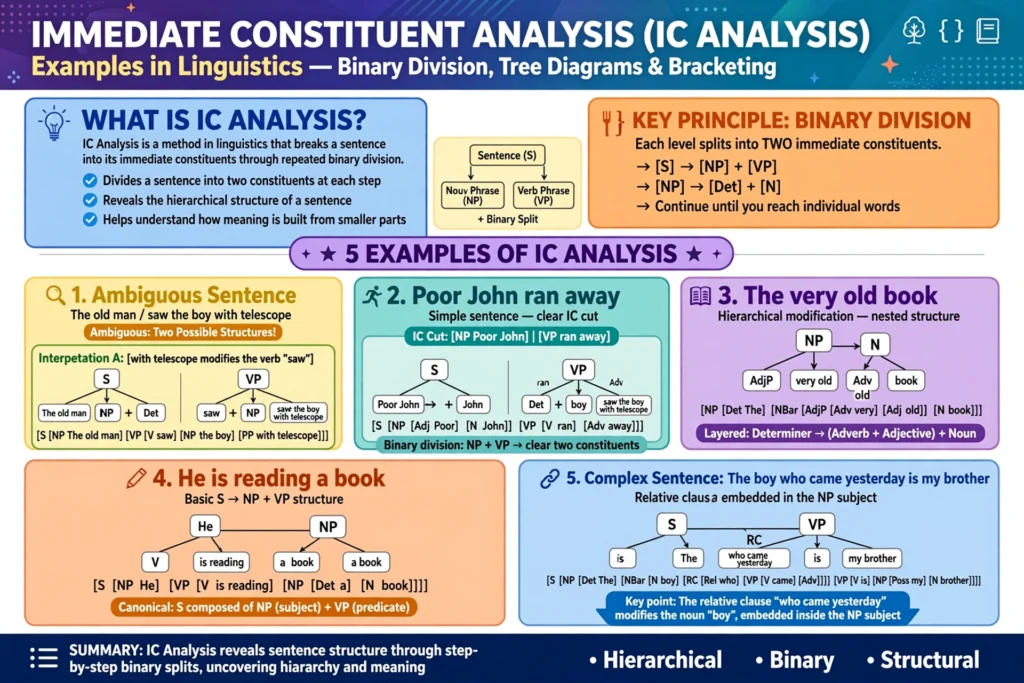
Example 1: The Simple Noun Phrase + Verb Phrase
Sentence: “The old dog barked.”
Linear view: The / old / dog / barked.
ICA view: [The old dog] + [barked].
But we don’t stop there. We cut each cluster into its immediate parts:
-
Cut 1 (The big split):
-
Constituent A: The old dog (Subject – Noun Phrase)
-
Constituent B: barked (Predicate – Verb Phrase)
-
-
Cut 2 (Breaking down the Subject):
-
The old dog splits into: The (Determiner) + old dog (Adjective + Noun).
-
old dog splits into: old (Adjective) + dog (Noun).
-
-
Cut 3 (Breaking down the Predicate):
-
barked is a single verb (no further split).
-
The Tree Diagram:
        S (Sentence)
       /            \
    NP (Noun Phrase)  VP (Verb Phrase)
    /      \              |
  Det    AdjP + N         V
   |      /    \          |
  The   old   dog      barked
Example 2: Why ICA Matters (Proving different structures)
Look at the phrase: “Very old books and magazines.”
This phrase is structurally ambiguous. ICA shows us why it has TWO distinct meanings:
-
Meaning A: The books are very old, and the magazines are very old. (Both are old).
-
Meaning B: The books are very old, but the magazines are just regular magazines. (Only the books are old).
ICA cuts this phrase in two entirely different ways:
Cut 1 (Meaning A – Both are old):
-
[Very old books] + [and magazines]
-
Wait, that makes it sound like “magazines” stands alone. Actually, for Meaning A, the structure is: [Very old] + [books and magazines].
-
Immediate Constituents: [[Very old] [books and magazines]]
Cut 2 (Meaning B – Only books are old):
-
[Very old books] + [and magazines]
-
Immediate Constituents: [[Very old books] [and magazines]]
Because the cut happens in a different place, the relationship of the word “old” changes. In Cut 1, “old” applies to the whole cluster books and magazines. In Cut 2, “old” only applies to books.
Example 3: The Classic Ambiguity (“Flying Planes”)
This is the ultimate textbook example for ICA.
Sentence: “Flying planes can be dangerous.”
This has two completely different meanings:
-
Meaning A: Planes that are in the air are dangerous. (Adjective + Noun)
-
Meaning B: The act of piloting planes is dangerous. (Verb + Object)
ICA reveals this through the first cut:
Cut 1 (Meaning A – Planes that fly):
-
The subject is [Flying planes] (a Noun Phrase).
-
Breaks down into: Flying (Adjective) + Planes (Noun).
-
-
The predicate is [can be dangerous].
-
Structure: [[Flying planes] [can be dangerous]]
Cut 1 (Meaning B – The act of piloting):
-
The subject is [Flying planes] (a Gerund Phrase / Verb Phrase acting as a noun).
-
Breaks down into: Flying (Verb) + Planes (Object of the verb).
-
-
The predicate is [can be dangerous].
-
Structure: [[Flying] [planes]] [can be dangerous]
Example 4: ICA vs. Linear Word Order (The Particle Problem)
Look at the phrasal verb: “He looked up the number.”
And its variant: “He looked the number up.”
A linear word-by-word analysis fails here. ICA proves that “up” and “looked” are a single semantic unit, regardless of where “up” appears in the sentence.
-
Structure: [[He] [[looked up] [the number]]]
-
Even though “up” is far from “looked” in the second sentence, ICA places them together in the same immediate constituent (Verb + Particle = “looked up”) because they function as one verb taking one object (“the number”).
Example 5: The “Fake” Cut (Why we don’t just split in half)
Consider: “The king of England died.”
A naive linear split might try to cut the sentence in half by word count: “The king of” + “England died”—but that produces nonsense.
Proper ICA: You must cut where the natural grammatical clusters are:
-
Cut 1: [The king of England] (Subject) + [died] (Verb).
-
Cut 2: Within the subject: [The] + [king of England].
-
Cut 3: Within that: [king] + [of England].
-
Cut 4: Within that: [of] + [England].
Why this matters: ICA proves that “of England” is a single constituent (a Prepositional Phrase) that modifies “king.” You cannot break “of” away from “England” because they form a tight immediate constituent before joining the rest of the sentence.
“ ICA Example: Disambiguating a whole sentence
Sentence: “She saw the man with the telescope.”
Meaning A: She used a telescope to see the man.
-
Cut 1: [She] [saw the man with the telescope]
-
Cut 2: [saw] [the man with the telescope] (Verb + Object)
-
Cut 3: [the man] [with the telescope] (The Prepositional Phrase with the telescope modifies the VERB “saw”—it is an Adjunct telling how she saw).
Meaning B: The man had a telescope.
-
Cut 1: [She] [saw the man with the telescope]
-
Cut 2: [saw] [the man with the telescope]
-
Cut 3: [the man with the telescope] (Here, with the telescope is INSIDE the Noun Phrase, modifying the man).
-
Cut 4: [the man] [with the telescope]
By breaking down the sentence into immediate constituents, we can see how the emotions are expressed and how they relate to the subject’s feelings.