Discover examples of the Grammar Translation Method and how this traditional approach can enhance your language learning experience. The main leaders of Grammar-Translation Method were basically Germans scholars like Ploetz, and Meidinger.In the United States of America this method was known as the Prussian Method.
When it comes to language learning and teaching, there are various methods and approaches that educators can choose from. One such method that has been used for centuries is the Grammar Translation Method. This article will explore the advantages of using the Grammar Translation Method in linguistics education.
Merits of the Method
- The foreign phraseology can be explained in a better and quicker way. Students can understand the meaning of words, phrases and idioms easily through their tongue. It avoids vagueness and makes teaching exact and definite.
- It increases the vocabulary of the students. The process is optimal and reliable in early stage of learning. It saves a good deal of time of the students.
- For the teacher, the method is very easy. He does not work hard to teach the students. It is also suitable for the average and below average teachers.
- The child learns English better with the help of his prior knowledge of mother tongue..
- The comprehension of the children can be tested easily by this method
- Emphasis is given to teach much vocabulary.
- The linguistic material is SET UP on a grammatical base plan
- Grammar is taught deductively; that is, by presentation of rules and principles which are habitually practiced through translation exercises in specific texts. Text is taught systematically with the help of grammatical rules.
- Reading of difficult texts is started early and the selection of reading material is selected from the literary text.
- Accuracy is emphasized not fluency.
- Reading and writing are the major objective and purpose.
Demerits of the Method
- The vocabulary, idioms and phrases of a particular nation seldom find a matching equivalent in any other language. For Example “a” and “the”, before a noun can hardly be translated. We cannot teach the difference ice and snow, or the words like “key in music”, “drawing-room” etc. to our through the translation of these terms.
- The sense of beauty of particular word or sentence is completely lost through translation.
- This method fails to catch the mind and arrest the soul of the learner.
- There is little provision for the training of speech. Reading and writing come before speaking. The oral work is totally neglected.
- It is a dull and mechanical method. The student becomes simply a passive recipient of knowledge.
- This method fails to create direct contact between thought and – expression. The children first think in their mother tongue and then they convert their ideas into English.
- The lesson based on grammatical principles is not suitable for the young learners. It becomes dry and burdensome.
- This method ignores all consideration of phonetics, pronunciation and fluency in speech.
- There is no opportunity for silent reading in this method. It does not help the pupils for self reading in future.
In spite of these merits and demerits of grammar translation method, it is still practiced in many second language acquisition countries.
Grammar Translation Method Examples In Linguistics.
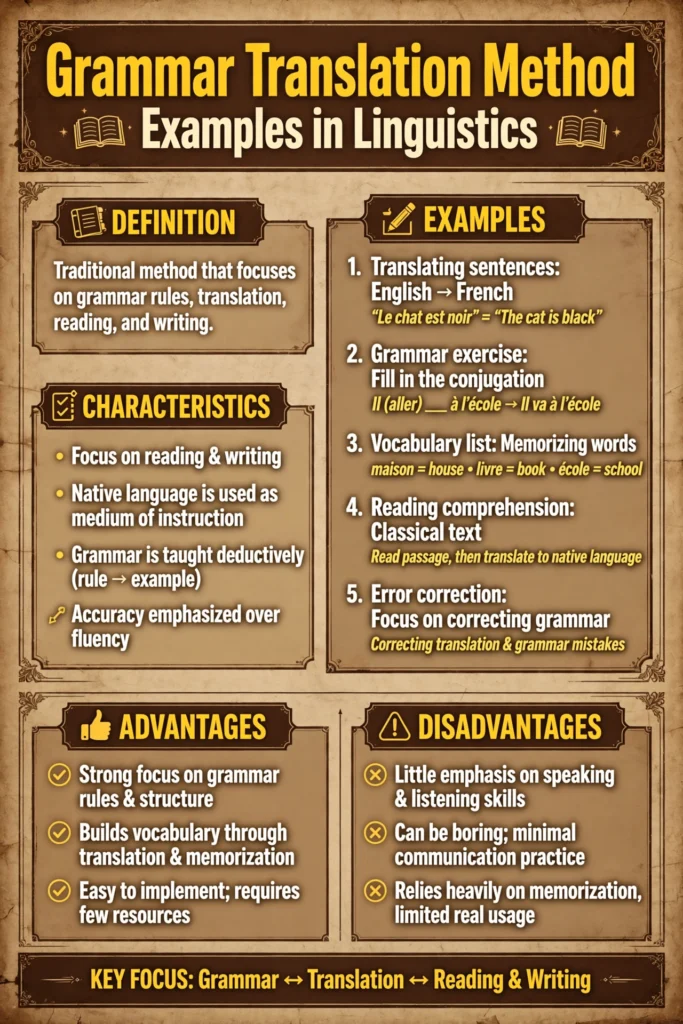
GTM is a deductive, text-heavy approach to language teaching. Its core beliefs are: (1) The goal of learning a language is to read its literature, not to speak it. (2) Grammar is the logical backbone of language, and it must be explicitly taught through rules. (3) Translation is the ultimate test of knowledge.
The Deductive Grammar Rule (Explicit Instruction)
The Method: The teacher does not let students discover grammar naturally. Instead, they present a rigid grammatical rule on the blackboard in the students’ native language (L1) first, followed by examples. The target language (L2) is treated as a puzzle to be solved using the L1.
-
Classroom Example (Teaching the Past Tense in English to French students):
-
Teacher writes on the board (in French): “To form the simple past tense in English, add ‘-ed’ to the base verb. For irregular verbs, memorize the second column of the irregular verb list.”
-
Teacher provides (in French): “Walk → Walked. Buy → Bought.”
-
Students copy the rule into their notebooks without hearing a single English conversation.
-
-
Critical Analysis: This treats language as math. It assumes that if you understand the theory of a tense, you can automatically use it. In reality, knowing that “buy” becomes “bought” does not teach a student the feeling of past time, nor does it train their ear to hear “bought” in a fast-paced sentence.
Word-for-Word Translation (Vocabulary Lists)
The Method: Vocabulary is taught exclusively through bilingual word lists. Students memorize long lists of isolated words and their direct native-language equivalents. There is zero context, no pictures, and no real-world usage.
-
Classroom Example (Teaching German to English speakers):
-
Teacher hands out a list:
-
Der Tisch = The table
-
Das Buch = The book
-
Die Katze = The cat
-
-
Homework: Students must memorize these 30 words for a quiz tomorrow where the teacher says “The table” and the student writes “Der Tisch.”
-
-
Critical Analysis: This is a catastrophic failure of cognitive linguistics. Words do not have perfect one-to-one equivalents across languages (e.g., the German “Gemütlichkeit” cannot be simply translated as “coziness”). By teaching isolated words, GTM ignores collocation (words that naturally go together) and forces students to mentally translate everything in their head before speaking, making them incredibly slow and unnatural speakers.
Fill-in-the-Blanks (Mechanical Application)
The Method: After presenting the rule, the teacher forces students to apply it over and over again in decontextualized, mechanical sentences. This is grammar for grammar’s sake.
-
Classroom Example (Teaching Spanish Ser vs. Estar to Americans):
-
Worksheet Instructions: “Fill in the blank with the correct form of ‘to be’ (ser/estar).”
-
Maria _____ muy alta. (Maria is very tall.) → Correct: es (ser).
-
Maria _____ enferma hoy. (Maria is sick today.) → Correct: está (estar).
-
-
Critical Analysis: The student gets the answer right by memorizing a mnemonic (“How you feel and where you are, always use the verb estar”). However, they never have to decide in real-time while having a fluid conversation whether they are talking about a permanent trait or a temporary state. In the real world, by the time you finish the mental mnemonic, the conversation has moved on.
Grammar Translation Method can be a useful tool for language learners when used in conjunction with other techniques. By incorporating translation exercises, vocabulary memorization, and grammar rules practice, students can improve their language skills and deepen their understanding of the target language. So, why not give the Grammar Translation Method a try in your language learning journey.