Explore examples of the Sapir-Whorf hypothesis in linguistics and how language shapes our perception of reality. Learn how language influences our thoughts and behaviors.
Sapir Whorf hypothesis is very important concept in linguistic study. In the hypothesis he said that language is not only to determine the pattern of culture, but also determine the manner and the way the human mind work. The idea that the varying cultural concepts and categories inherent in different languages affect the cognitive classification of the experienced world in such a way that speakers of different languages think and behave differently because of it. Roger Brown has drawn a distinction between weak linguistic relativity, where language limits thought, and strong linguistic relativity, where language determines thought.
The idea that linguistic structure influences the cognition of language users has bearings on the fields of anthropological linguistics, psychology, sociolinguistics, sociolinguistics, cognitive science, linguistic anthropology, sociology of language and philosophy of language, and it has been the subject of extensive studies in all of these fields. The idea of linguistic influences on thought has also captivated the minds of authors and creative artists inspiring numerous ideas in literature, in the creation of artificial languages and even forms of therapy such as neuro-linguistic programming.
According to Edward Sapir and Benjamin Whorf, language is not only acts as a mechanism for ongoing communication, but also as a guide in the direction of social reality. In other words, the language does not only reflect the perceptions, thoughts and experiences, but also be able to determine and shape, With another meaning people of different languages: Indonesian, English, Japanese, Chinese, Korean, and others are likely to see the same reality in a different way as well. The implication languages can also be used to give a particular accent to an event or action, such as an emphasis, sharpen, soften, exalting, harassing, etc
Sapir-Whorf hypothesis Examples In Linguistics.
LINGUISTIC RELATIVITY AND ITS MANIFESTATIONS:
It has often been claimed that linguistic relativity is a weaker form of linguistic determinism. But the strong–weak distinction oversimplified the more complicated picture that is emerging in recent research on the relationship between language and thought. Linguistic relativity can now be said to comprise a ‘family’ of related proposals that do not necessarily fall along a single strong-to-weak continuum. In this article, we examine the arguments and evidence for several branches of the ‘family tree’ shown in Figure 1. Our overall conclusion will be that the proposals we call language as language-of-thought and linguistic determinism can be rejected on both theoretical and empirical grounds, but that recent findings support a range of alternative ways in which language might have significant effects on thought, leading to possible differences in thought across language communities.
Development of this idea
The idea was first expressed clearly in the German national romantic thought of the early 19th century where language was seen as the expression of the spirit of a nation, as put particularly by Wilhelm von Humboldt. It was later embraced by figures in the incipient school of American anthropology such as Franz Boas and Edward Sapir. Sapir’s student Benjamin Lee Whorf added observations of how he perceived these linguistic differences to have consequences in human cognition and behaviour. Whorf has since been seen as the primary proponent of the principle of linguistic relativity. Whorf’s insistence on the importance of linguistic relativity as a factor in human cognition attracted opposition from many sides. Psychologists Roger Brown and Eric Lunenburg decided to put Whorf’s assumptions and assertions to the test.
They formulated the principle of linguistic relativity as a testable hypothesis and undertook a series of experiments testing whether traces of linguistic relativity could be determined in the domain of color perception. In the 1960s the idea of linguistic relativity fell out of favor in the academic establishment, since the prevalent paradigm in linguistics and anthropology, personified in Noam Chomsky, stressed the universal nature of human language and cognition. When the 1969 study of Brent Berlin and Paul Kay showed that color terminology is subject to universal semantic constraints, the Sapir Whorf hypothesis was seen as completely discredited.
From the late 1980s a new school of linguistic relativity scholars, rooted in the advances within cognitive and social linguistics, have examined the effects of differences in linguistic categorization on cognition, finding broad support for the hypothesis in experimental contexts. Effects of linguistic relativity have been shown particularly in the domain of spatial cognition and in the social use of language, but also in the field of color perception.
Recent studies have shown that color perception is particularly prone to linguistic relativity effects when processed in the left brain hemisphere, suggesting that this brain have relies more on language than the right one. Currently a balanced view of linguistic relativity is espoused by most linguists holding that language influences certain kinds of cognitive processes in non-trivial ways but that other processes are better seen as subject to universal factors.
The formulation of the linguistic relativity, for which Whorf is famous, was the result of his prolonged study of the Hopi language (an American Indian language). His first attempts at interpreting the Hopi grammar according to the usual indo-European categories were abandoned when they produced unexplainable irregularities. The linguistic structures that he found were very different from those of his mother tongue, English. Whorf argues that this implies a different way of thinking. Since thought is expressed through language, it follows that a differently structured language must pattern thought along its lines, thus influencing perception.
To understand the Sapir-Whorf hypothesis (also called linguistic relativity), we need to start with its core claim:
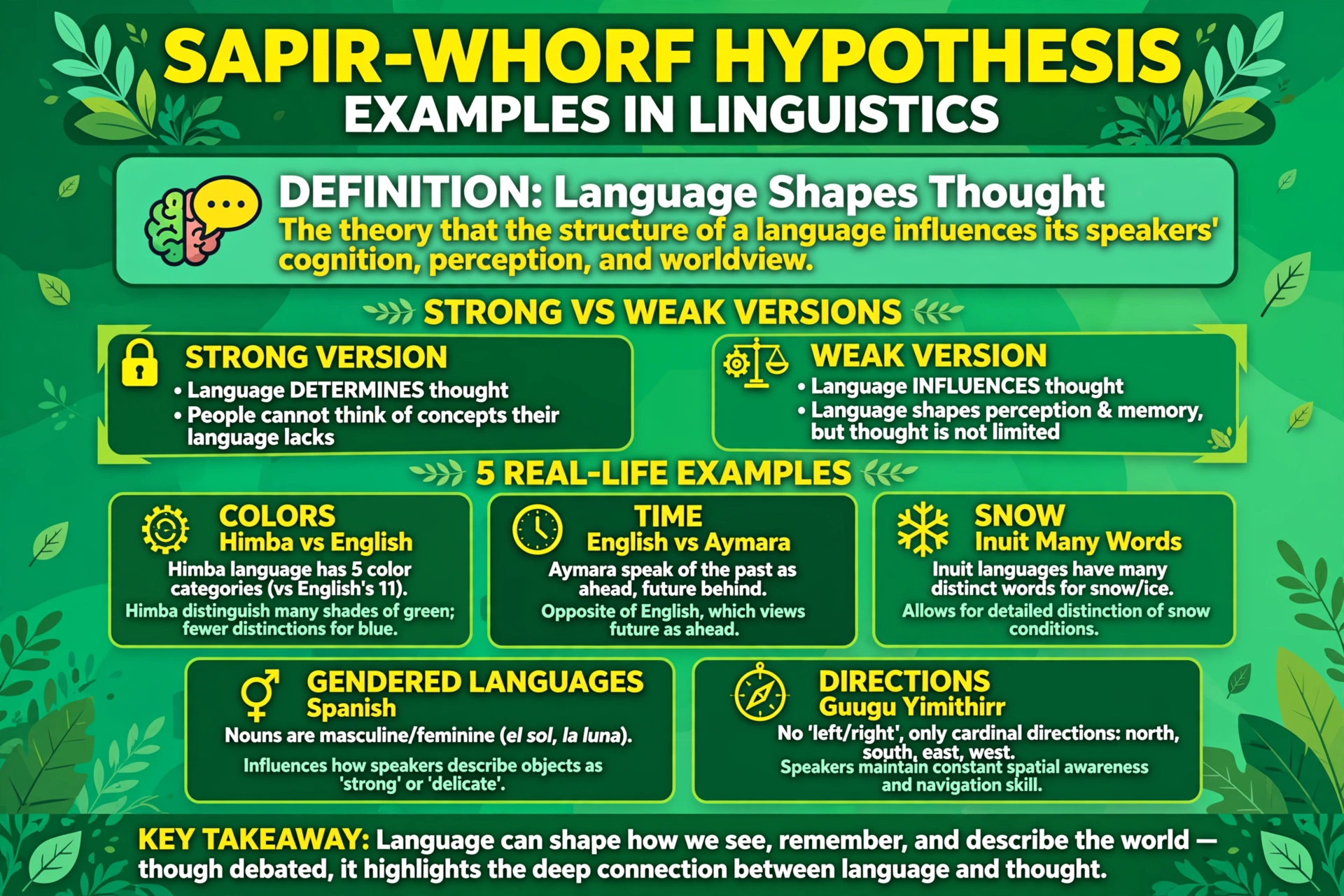
The language you speak influences (or even determines) how you think, perceive reality, and categorize the world.
Linguists split this into two main versions:
-
Linguistic Determinism (Strong Version): Language determines thought. You can only think what your language allows. (Mostly rejected by modern linguistics.)
-
Linguistic Relativity (Weak Version): Language influences thought. Different languages lead to different cognitive habits and perceptions. (Widely accepted with evidence.)
Below are detailed, real-world examples from linguistics, psychology, and anthropology that demonstrate the Sapir-Whorf hypothesis in action.
CATEGORY 1: COLOR PERCEPTION (The Classic Example)
Different languages divide the color spectrum differently, affecting how speakers perceive and remember colors.
| Language | Example | Linguistic Relativity Effect |
|---|---|---|
| English | We have 11 basic color terms: black, white, red, green, yellow, blue, brown, purple, pink, orange, gray. | English speakers easily distinguish blue from green because we have separate words for them. |
| Russian | Has two separate basic terms for light blue (goluboy) and dark blue (siniy). | Russian speakers are faster and more accurate at distinguishing light blue from dark blue than English speakers in cognitive tests. They perceive these as two different colors, not shades of one. |
| Himba (Namibia) | Has only five basic color terms. They use one word (zoozu) for dark blue, dark green, and black. | Himba speakers struggle to distinguish a blue square from a green square (which look identical to them) but can easily distinguish two shades of green that English speakers see as identical. |
| Greek | Has separate terms for light blue (ghalazio) and dark blue (ble). | Similar to Russian, Greek speakers categorize blues faster than English monolinguals. |
| Hanunó’o (Philippines) | Has no basic color terms for “blue” or “green.” Instead, they categorize by texture and moisture: (latuy) for light/white, (mayit) for dark/black, (rara) for red/orange, and (marigta) for green/fresh/wet. | Hanunó’o speakers pay more attention to the physical condition (wet vs. dry) of plants and objects rather than their abstract hue. |
CATEGORY 2: SPATIAL ORIENTATION (How We Navigate)
Languages use different coordinate systems to describe space, which trains speakers to think about direction differently.
| Language | Example | Linguistic Relativity Effect |
|---|---|---|
| English | Uses egocentric (self-centered) coordinates: left, right, in front of, behind. (“The ball is to your left.”) | English speakers rely on their own body position. If you spin them around, they get confused about left/right. |
| Guugu Yimithirr (Australia) | Uses absolute (cardinal) coordinates: north, south, east, west for everything, even tiny objects. (“The cup is south of the plate.”) | Speakers always know exactly which way north is, even in dark rooms or unfamiliar buildings. They are trained from childhood to maintain a mental compass. They cannot say “left” or “right” at all. |
| Tzeltal (Mexico) | Uses geocentric coordinates based on terrain (uphill vs. downhill), not left/right. (“The cup is uphill from the plate.”) | Speakers orient everything based on the slope of the land, even when indoors. Their spatial memory is tied to topography, not their own bodies. |
| Korean | Uses different verbs for spatial relationships based on whether objects are tightly fitted (kkita) vs. loosely placed (nehta). | Korean speakers pay more attention to the fit between objects (e.g., a ring on a finger vs. a book on a table) than English speakers, who just say “put.” |
CATEGORY 3: TIME PERCEPTION (How We Think About the Past & Future)
How languages metaphorically structure time affects how speakers think about it.
| Language | Example | Linguistic Relativity Effect |
|---|---|---|
| English | Uses horizontal spatial metaphors for time: “looking forward” to the future, “looking back” to the past. | English speakers mentally arrange time from left to right (past on the left, future on the right). |
| Mandarin Chinese | Uses vertical metaphors for time: “up” for earlier events and “down” for later events. (e.g., shàngyuè = “up-month” = last month; xiàyuè = “down-month” = next month). | Mandarin speakers are faster at identifying temporal relationships when presented vertically (top-to-bottom) than horizontally. Their cognitive map of time is vertical. |
| Aymara (Andes) | Speakers conceptualize the past as being IN FRONT of them (because they can “see” the past) and the future as being BEHIND them (because it is unknown). | Aymara speakers point backward when talking about the future and forward when talking about the past—the exact opposite of English speakers. |
| Greek & English | Greek uses the verb pao (“to go”) for future events; English uses “will” and “gonna.” | Speakers of languages with explicit future markers (like English) tend to undervalue future rewards (thinking of the future as “distant”). Speakers of languages with no future tense (like German or Japanese, which use present tense for future) are more likely to save money for retirement. |
CATEGORY 4: GRAMMATICAL GENDER (Animate vs. Inanimate Objects)
In languages with grammatical gender, speakers unconsciously assign human-like traits to objects based on their gender category.
| Language | Example | Linguistic Relativity Effect |
|---|---|---|
| German | The word for “bridge” (Brücke) is feminine (die). | German speakers describe bridges with feminine adjectives: “beautiful,” “elegant,” “slender.” |
| Spanish | The word for “bridge” (puente) is masculine (el). | Spanish speakers describe bridges with masculine adjectives: “strong,” “big,” “sturdy.” |
| German | The word for “key” (Schlüssel) is masculine. | Germans describe keys as heavy, jagged, hard. |
| Spanish | The word for “key” (llave) is feminine. | Spanish speakers describe keys as little, shiny, lovely. |
| French | The word for “table” (table) is feminine; the word for “fork” (fourchette) is feminine; the word for “knife” (couteau) is masculine. | French speakers spontaneously assign gender-stereotyped personalities to inanimate objects in psychological tests (e.g., imagining a “feminine” table and a “masculine” knife). |
CATEGORY 5: COUNT VS. MASS NOUNS (How We Think About Objects vs. Substances)
Languages that force speakers to categorize nouns as “countable” or “uncountable” affect how they perceive quantity.
| Language | Example | Linguistic Relativity Effect |
|---|---|---|
| English | Distinguishes count nouns (chair, dog, apple) from mass nouns (water, sand, furniture). You say “much water” but “many chairs.” | English speakers automatically classify objects as discrete units versus continuous substances. |
| Yucatec Maya | Uses classifiers for all nouns—you cannot say “two pigs” without adding a unit, like “two long-things pigs” or “two rounded-things pigs.” | Maya speakers pay more attention to the shape, material, and consistency of objects. They remember what things are made of (e.g., wood vs. stone) better than English speakers, who focus more on the object’s function. |
| Japanese | Uses counter words (hon, mai, ko) depending on the object’s shape (long/flat/round). | Japanese speakers are more attuned to shape and dimension than speakers of languages without mandatory classifiers. |
CATEGORY 6: EVENT PERCEPTION (Active vs. Passive Framing)
Languages that emphasize agency vs. accident affect how speakers assign blame and remember events.
| Language | Example | Linguistic Relativity Effect |
|---|---|---|
| English | Uses agentive constructions even for accidents: “She broke the vase.” | English speakers remember who did the action even when it was accidental. They are more likely to assign blame. |
| Spanish / Japanese | Uses non-agentive constructions for accidents: “Se rompió el florero” = “The vase broke itself.” / “Garasu ga wareta” = “The glass broke.” | Spanish and Japanese speakers are less likely to remember who broke the vase. They focus on the event rather than the agent. In eyewitness testimony studies, Spanish speakers were significantly worse at remembering the person who accidentally broke an object. |
| Turkish | Uses evidentiality markers—you must add a suffix to verbs to show if you directly witnessed the event or heard about it second-hand. (-mIş marks hearsay). | Turkish speakers are constantly paying attention to the source of their knowledge. They distinguish “I saw it happen” from “I was told it happened” in every single past-tense sentence. |
CATEGORY 7: EMOTION & AFFECT (How We Feel)
Languages categorize emotional states differently, influencing how speakers experience and express feelings.
| Language | Example | Linguistic Relativity Effect |
|---|---|---|
| English | Has only one word for “sadness.” | English speakers lump all negative low-arousal emotions into one broad category. |
| German | Has Weltschmerz – “world-pain” (a deep sadness about the state of the world) and Torschlusspanik – “gate-closing panic” (the fear of time running out). | German speakers have precise, culturally-specific emotional concepts that English lacks. |
| Russian | Has two separate words for “blue” but also distinct words for different types of sadness: toska (deep spiritual anguish) vs. grust (ordinary sadness). | Russian speakers differentiate between existential melancholy and everyday sadness. |
| Tahitian | Has no word for sadness or grief as a single concept. They use phrases like “feeling bad” or “having a heavy heart.” | Tahitian speakers conceptualize negative emotions as physical states or social disturbances rather than internal psychological states. |
CATEGORY 8: NUMBER SYSTEMS (Counting & Mathematics)
How languages frame numbers affects mathematical cognition.
| Language | Example | Linguistic Relativity Effect |
|---|---|---|
| English | Decimal system (base-10) with a regular pattern: twenty-one, twenty-two. | English speakers easily handle numbers up to 1,000. |
| Pirahã (Amazon) | Has no words for exact numbers—only terms for “few” and “many.” | Pirahã speakers cannot do exact counting, cannot perform simple arithmetic (e.g., 2+2), and fail at tasks requiring memory for specific quantities. Their cognition is not “limited”—they just don’t think in exact quantities. |
| East Asian languages (Chinese, Japanese, Korean) | Number words are extremely short and transparent: 11 = “ten-one”; 12 = “ten-two”. | Chinese-speaking children learn to count to 40 a full year earlier than English-speaking children. The language makes the base-10 system visually obvious, whereas English has irregular teens (eleven, twelve, thirteen). |
CATEGORY 9: AGENCY & BLAME (Forensic Linguistics)
Real-world legal evidence that language influences perception of guilt.
| Language | Example | Linguistic Relativity Effect |
|---|---|---|
| English | “John broke the lamp.” (Active voice, assigns agency) | English speakers spontaneously remember John as the cause. |
| English | “The lamp was broken.” (Passive voice, downplays agency) | English speakers remember less about who broke the lamp. |
| Spanish | “Se rompió la lámpara.” (Reflexive passive: “The lamp broke itself.”) | Spanish speakers are far less likely to remember John or assign blame. |
| Forensic Study | Eyewitnesses of a car accident were asked: “How fast were the cars going when they smashed into each other?” vs. “hit each other?” | Those asked with smashed reported much higher speeds and were more likely to claim they saw broken glass (which wasn’t there). The verb semantically anchored their memory. |
CATEGORY 10: SELF-CONCEPT (Individualist vs. Collectivist Languages)
Languages that require speakers to mark social relationships affect how they see themselves.
| Language | Example | Linguistic Relativity Effect |
|---|---|---|
| English | Uses the same pronoun (you) for family, friends, strangers, and bosses. | English speakers conceptualize others as independent individuals. Social relationships are not grammatically forced. |
| Japanese | Uses multiple levels of politeness and different pronouns (anata, kimi, omae) based on social rank, age, and intimacy. | Japanese speakers are constantly aware of their social standing relative to the listener. Their language forces them to consider hierarchy in every sentence. |
| Javanese | Has three distinct registers (low, middle, high) based entirely on the social status of the person you are speaking to. A speaker must choose verbs and vocabulary differently for a peasant vs. a king. | Javanese speakers cannot speak without mentally categorizing their listener’s social class. This reinforces a deeply hierarchical worldview. |
The Critical Takeaway in Modern Linguistics:
| Version | Claim | Status |
|---|---|---|
| Linguistic Determinism (Strong) | Language determines thought. You cannot think outside your language’s categories. | Rejected. Evidence shows people can learn new concepts even without words for them (e.g., Pirahã can learn numbers if taught). |
| Linguistic Relativity (Weak) | Language influences thought, habitual attention, memory, and categorization. | Accepted. The examples above (Russian blues, Guugu Yimithirr compass, Spanish blame) prove that language shapes cognitive habits, not cognitive limits. |
A Famous Modern Quote to Remember:
“Language is not a prison for thought, but it is a pair of glasses. It doesn’t stop you from seeing, but it does tint and focus what you notice.”
— (Paraphrased from Lera Boroditsky, Stanford cognitive scientist).
CONCLUSION:
Whorf may not have been right on all counts, but he was not wrong either. The fact that language plays a role in shaping our thoughts, in modifying our perception and in creating reality is irrefutable. Gipper phrased the question properly when he asked; to what extent does language influence us? In view of the positive (favorable to the hypothesis), or neutral results which the different tests have yielded, it would seem that the question of linguistic relativity is still a subject of controversy today. Although the search for linguistic universals has been intensified, it will be impossible to determine what is universal, if we don‟t know what is particular. Linguistic forms and grammatical categories need not appear so different, if their functions are similar.