Social Psychology Examples are in action from conformity and obedience to the bystander effect and cognitive dissonance.These examples of social psychology illustrate the complex ways in which our social interactions shape our thoughts, feelings, and behaviors. By understanding these phenomena, we can gain insights into why we behave in certain ways in social situations.
Social Psychology Examples You Must Know.
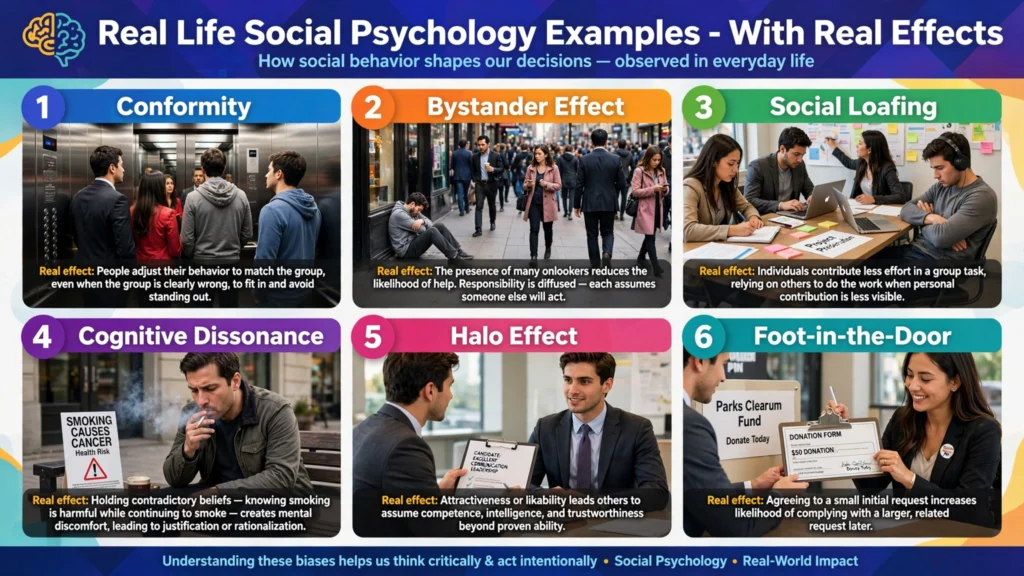
To understand social psychology, it helps to see it not as a collection of abstract theories, but as a mirror held up to our daily lives. It explains why we act differently in crowds than we do alone, why we conform to unwritten rules, and why we sometimes hurt or help each other.
Here is a detailed exploration of five foundational pillars of social psychology, brought to life with vivid, real-world examples.
1. Conformity: The Chameleon Effect
The Theory: Conformity is the act of changing your behavior, beliefs, or attitudes to align with a group standard. We conform for two primary reasons: Informational Influence (we assume the group knows more than we do, especially in ambiguous situations) and Normative Influence (we want to be liked and accepted, so we go along with the group to avoid rejection).
The Classic Study: Solomon Asch’s 1950s line experiment. Participants were shown a standard line and asked to match it to one of three comparison lines. When alone, people got it right 99% of the time. However, when surrounded by a group of actors who purposely chose the wrong line, a staggering 75% of participants conformed and gave the wrong answer at least once, just to fit in.
Detailed Real-World Example: Imagine you are a new hire at a corporate law firm. On your first day, you notice that everyone in the office wears formal business suits—no casual Fridays, no polo shirts. You prefer smart-casual attire, but you show up in a three-piece suit anyway. This is normative conformity; you are conforming to the group’s dress code to gain acceptance and avoid the awkwardness of standing out.
Now, consider a crisis scenario. You are in a meeting when the fire alarm goes off. No one else moves; they continue typing and chatting. You look around, confused. Because the situation is ambiguous (you don’t see smoke or flames), you assume your coworkers know something you don’t. So, you stay seated. This is informational conformity—you used the group’s inaction as evidence that the alarm was a false trigger.
2. Obedience: The Power of Authority
The Theory: Obedience involves following direct orders from a perceived authority figure. Unlike conformity (which is peer-driven), obedience is hierarchical. It is deeply ingrained in us through socialization—we are taught to obey parents, teachers, police, and bosses. The dark side of obedience is that it can override our personal moral compass.
The Classic Study: Stanley Milgram’s 1963 shock experiment. Participants were told to administer electric shocks to a “learner” (an actor) every time they made a mistake. The shocks increased up to a deadly 450 volts. Despite the learner screaming in pain and begging to stop, 65% of participants continued to the very end simply because a stern man in a lab coat (the authority figure) told them, “The experiment requires that you continue.”
Detailed Real-World Example: Think about a nurse in a busy hospital. A doctor (a clear authority figure) calls the nurse and says, “Give 20 milligrams of a specific medication to the patient in Room 4 immediately.” The nurse knows that the standard dosage for that drug is 5 milligrams. Giving 20 mg could kill the patient. However, because the doctor is an authority figure, the nurse hesitates. In real-life historical studies, nurses have admitted they would administer the dose just to obey the doctor’s order, even if the prescription was illegible or dangerously wrong.
A more positive example is a flight crew. When a captain gives a command during an emergency, the co-pilot obeys without question. This obedience is essential for safety. However, it becomes dangerous if the captain makes a terrible error (e.g., flying into a storm) and the co-pilot obeys rather than challenging the authority, leading to a catastrophic crash.
3. The Bystander Effect: The Paradox of Crowds
The Theory: The bystander effect occurs when the presence of others discourages an individual from intervening in an emergency. The greater the number of bystanders, the less likely anyone is to help. This happens due to diffusion of responsibility (everyone assumes someone else will take action) and pluralistic ignorance (we look to others to see how to react; if they are calm, we assume it’s not an emergency).
The Classic Study: The tragic murder of Kitty Genovese in 1964, where 38 witnesses reportedly failed to call the police, sparked this research. Latane and Darley later proved in a lab that if a participant was alone in a room and smoke started pouring in, they would report it 75% of the time. But if they were in a room with two other passive people, they reported it only 10% of the time.
Detailed Real-World Example: You are driving on a busy interstate highway at rush hour. You see a car on the shoulder with its hazard lights flashing and a woman standing outside looking at a flat tire, clearly distressed. Do you stop? Probably not. Because the highway is packed with hundreds of other drivers, you think, “Surely one of them will call a tow truck, or someone with more mechanical knowledge will pull over.” That is diffusion of responsibility.
Meanwhile, the woman is terrified because she doesn’t have a jack. She notices that as cars whiz by, drivers are staring straight ahead, pretending not to see her. Because they look calm and unconcerned, she begins to doubt her own assessment of the danger. She thinks, “Maybe I’m overreacting; it’s not that dangerous.” This is pluralistic ignorance. Ironically, if just one driver slows down to look, the spell is broken; other drivers will then interpret the situation as an emergency and pull over too, because the ambiguity has been resolved.
4. Cognitive Dissonance: The Discomfort of Hypocrisy
The Theory: Cognitive dissonance is the psychological discomfort we experience when our actions contradict our beliefs or self-image. Because we hate feeling inconsistent, we subconsciously change our attitudes to justify our behavior. It is our brain’s way of protecting our ego.
The Classic Study: Leon Festinger’s 1959 experiment. Participants were asked to perform a mind-numbingly boring task (turning pegs on a board). Afterwards, they were paid either $1 or $20 to tell the next participant that the task was actually fun and exciting. Those paid only $1 convinced themselves they actually *did* enjoy the task (they changed their attitude), because they couldn’t justify lying for just one dollar. Those paid $20 had an external justification (the money), so they maintained that the task was boring.
Detailed Real-World Example: Imagine a young man, David, who prides himself on being a health-conscious athlete and a vegan for ethical reasons. One night, after a stressful week, he gets drunk and eats an entire pepperoni pizza. When he wakes up, he feels a wave of guilt and anxiety. This is the dissonance: “I am a healthy, ethical vegan” clashes with “I just ate a dead animal covered in grease.”
David cannot undo the act, but he needs to relieve the discomfort. He will subconsciously choose one of three routes to resolve this:
-
Change the behavior: He vows to never drink alcohol again (hard to maintain).
-
Change the cognition: He tells himself, “Well, I only eat meat once every few months. I’m not a strict vegan; I’m a ‘flexitarian.’ It’s actually healthier to have a varied diet.” (He changes his belief about what he is).
-
Add new cognitions: He thinks, “That pizza was a one-time reward for surviving a horrible workweek. Mental health is more important than physical health, and I needed that comfort food.” (He justifies the action by adding a new, higher-value belief).
By the end of the day, he no longer feels guilty. He now believes that eating pepperoni pizza occasionally is a sign of good mental health.
5. Prejudice and In-Group Bias: The Us vs. Them Mentality
The Theory: Prejudice is a negative, preconceived judgment about a group and its individual members, held without sufficient evidence. It stems from social categorization (we automatically divide the world into “us” and “them”), in-group bias (we favor our own group), and out-group homogeneity (we perceive “them” as all being alike, while “we” are diverse). This is often fueled by the scapegoat theory—blaming an out-group for our own problems to protect our self-esteem.
The Classic Study: The Robbers Cave Experiment by Muzafer Sherif. He took 11-year-old boys to a summer camp and split them into two groups (the Eagles and the Rattlers). Within days, they formed fierce in-group loyalties and began hurling insults at the opposing group. They developed prejudices based purely on arbitrary group assignment.
Detailed Real-World Example: Consider a workplace scenario. The company merges with a rival firm. You are in the “West Coast Division” (in-group) and the new employees are the “East Coast Division” (out-group). Immediately, you begin to stereotype them: “East Coast people are aggressive and rude; they micromanage.” Meanwhile, your team thinks, “We are laid-back, creative, and collaborative.”
When a project goes over budget, your team immediately blames the East Coast managers for their “reckless spending” (scapegoating). However, when your team goes over budget, you attribute it to “unforeseen market changes” (a situational excuse). This is the ultimate attribution error—we attribute our successes to internal factors (our hard work) and our failures to external factors (bad luck), while doing the exact opposite for the out-group.