Explore semantics examples sentences to understand the meaning of words and sentences. Improve your semantics skills with these practical tips.Meaning is more than denotation and connotation. What a word means depends in part on its associations with other words, the relational aspect. Lexemes do not merely ‘have’ meanings; they contribute meanings to the utterances in which they occur, and what meanings they contribute depends on what other lexemes they are associated with in these utterances.
The meaning that a lexeme has because of these relationships is the sense of that lexeme. Part of this relationship is seen in the way words do, or do not, go together meaningfully. It makes sense to say John walked and it makes sense to say An hour elapsed. It doesn’t make sense to say John elapsed or An hour walked. Part of the meaning of elapse is that it goes with hour, second, minute, day but not with John, and part of the meaning of hour, second and so forth is that these words can co-occur with elapse.
Part of the relationship is seen in the way word meanings vary with context. A library is a collection of books (Professor Jones has a rather large library) and is also a building that houses a collection of books (The library is at the corner of Wilson and Adams Streets). A number of English verbs can be used in two different ways —different grammatical association—and then have slightly different meanings. We can say:
A window broke.
Tom broke a window.
Here what happened to the window is the same, but in the first sentence broke is equivalent to ‘became broken’ and in the second it is equivalent to ‘caused to be broken.’ Adjectives, too, can have different senses. If you come across some object which you have never seen before, and you wonder about its origin and its purpose, we can say that you are curious about it. But we can also call the object a curious kind of thing.
List of Semantics Examples Sentences In Linguistics.
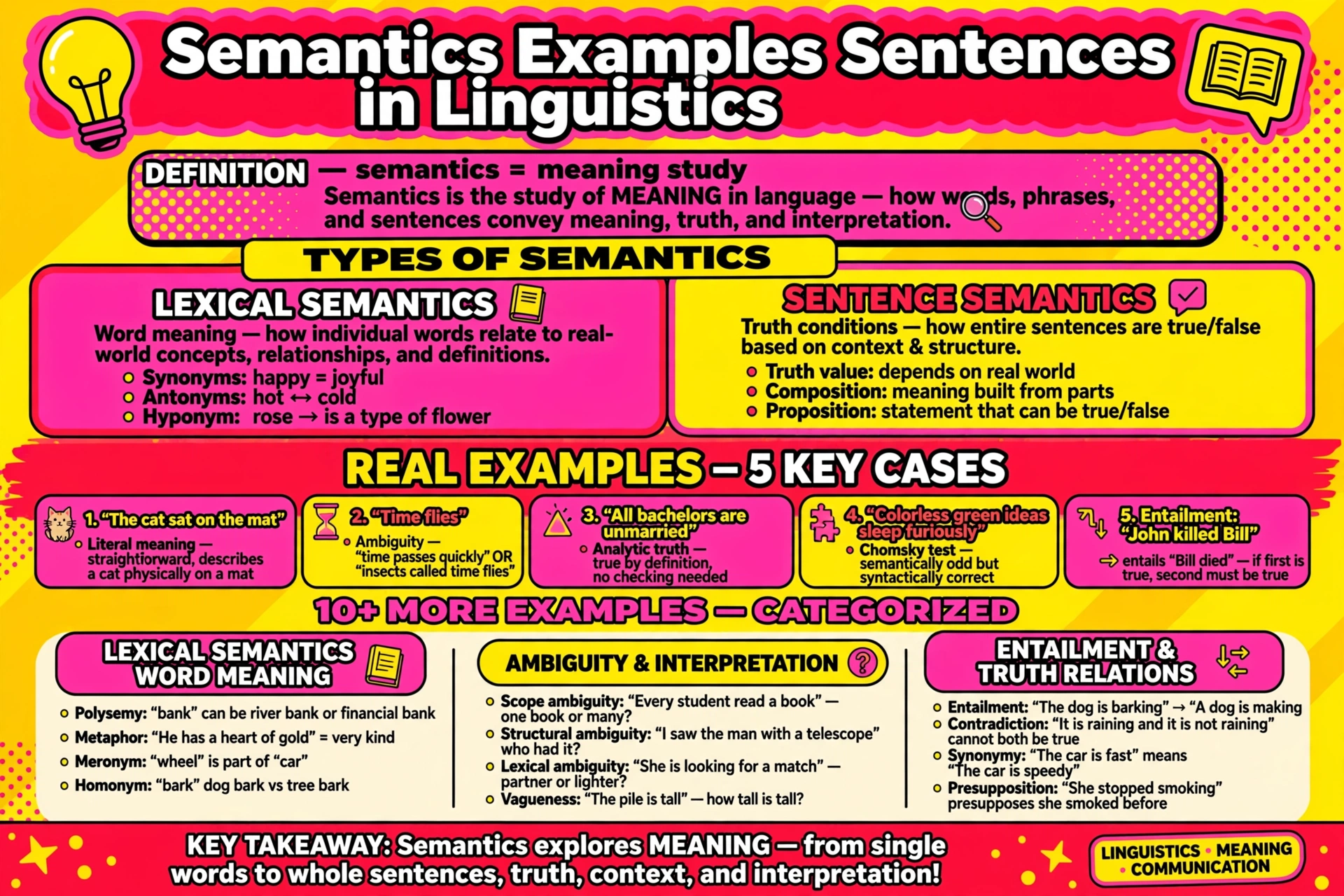
To give semantics examples sentences in linguistics, we need to look at different semantic phenomena.Below are 100 sentences, each labeled with the specific semantic concept it demonstrates. I’ve organized them into 10 semantic categories with 10 examples each.
CATEGORY 1: POLYSEMY (One word, multiple related meanings)
Sentences where a single word carries multiple, historically connected meanings.
-
“Head” – She hit her head on the shelf. (Body part)
-
“Head” – He is the head of the department. (Leader)
-
“Head” – Pour the beer until it has a thick head. (Foam on top)
-
“Foot” – My foot is aching. (Body part)
-
“Foot” – We camped at the foot of the mountain. (Bottom)
-
“Paper” – The printer needs more paper. (Material)
-
“Paper” – I have to write a term paper by Friday. (Essay)
-
“Run” – I run every morning at 6 AM. (Physical motion)
-
“Run” – She runs a multi-million dollar company. (Manage)
-
“Run” – My nose will not stop running. (Flow/discharge)
CATEGORY 2: HOMONYMY (Same spelling/sound, unrelated meanings)
Sentences where two different words happen to share a form but have no historical connection.
-
“Bank” – I deposited my paycheck at the bank. (Financial institution)
-
“Bank” – We sat on the grassy bank of the river. (River edge)
-
“Bat” – The bat flew out of the cave. (Flying mammal)
-
“Bat” – He swung the bat and hit a home run. (Sports equipment)
-
“Spring” – The spring broke and the mattress sank. (Coiled metal)
-
“Spring” – Spring is my favorite season. (Season of the year)
-
“Date” – What is today’s date? (Calendar day)
-
“Date” – I ate a sweet date for a snack. (Fruit)
-
“Rose” – She received a red rose. (Flower)
-
“Rose” – He rose from his chair and left. (Past tense of “rise”)
CATEGORY 3: SYNONYMY (Different words, same/similar meaning)
Sentences showing near-identical meanings, but with subtle stylistic or connotative differences.
-
The child was scared of the dark.
-
The child was frightened of the dark.
-
The child was terrified of the dark. (Intensity difference)
-
He is a wealthy man.
-
He is a rich man. (Wealthy = more formal/objective)
-
She gave a quick reply.
-
She gave a swift reply. (Swift = slightly more literary)
-
The room was small.
-
The room was tiny. (Tiny = more emphatic)
-
The room was compact. (Compact = implies efficient use of space)
CATEGORY 4: ANTONYMY (Opposite meanings)
Sentences demonstrating different types of opposites.
Complementary Antonyms (either/or, no middle ground):
-
The light is on. / The light is off.
-
The door is open. / The door is closed.
-
He is alive. / He is dead.
Gradable Antonyms (existence of a middle ground):
-
The water is hot. / The water is cold. (Can be warm)
-
She is tall. / She is short. (Can be average height)
-
This road is wide. / This road is narrow. (Can be medium)
-
The soup is sweet. / The soup is sour. (Can be bland)
Relational Antonyms (reversible relationships):
-
She is his wife. / He is her husband.
-
I am your student. / You are my teacher.
-
She bought the seller‘s house. / She sold the house to the buyer.
CATEGORY 5: HYPONYMY & HYPERNYMY (Hierarchical relationships)
Sentences showing inclusion (hyponym = specific; hypernym = general).
-
A dog is a type of animal. (Dog = hyponym; Animal = hypernym)
-
A rose is a type of flower. (Rose = hyponym; Flower = hypernym)
-
A sedan is a type of car. (Sedan = hyponym; Car = hypernym)
-
An oak is a type of tree. (Oak = hyponym; Tree = hypernym)
-
A sparrow is a type of bird. (Sparrow = hyponym; Bird = hypernym)
-
Furniture includes items like chairs and tables.
-
Vehicles include trucks, bicycles, and motorcycles.
-
Color includes red, blue, and yellow.
-
A puppy is a young dog. (Cross-category hyponymy)
-
A kitten is a young cat.
CATEGORY 6: MERONYMY (Part-whole relationships)
Sentences where one word is a part of another.
-
The wheel is part of the car.
-
The page is part of the book.
-
The finger is part of the hand.
-
The roof is part of the house.
-
The branch is part of the tree.
-
The screen is part of the phone.
-
The door is part of the room.
-
The engine is part of the airplane.
-
The capital is part of the country. (Political meronymy)
-
The chorus is part of the song.
CATEGORY 7: ENTAILMENT (Logical consequence between sentences)
Sentences where the truth of one necessarily makes the other true.
-
John killed the mosquito. ⟹ The mosquito died.
-
She bought a new car. ⟹ She has a new car. (In most contexts)
-
He married her. ⟹ He knows her.
-
The glass shattered. ⟹ The glass broke.
-
I walked to the store. ⟹ I moved from my house.
-
She sneezed. ⟹ She made a noise.
-
He murdered the man. ⟹ The man died.
-
They kissed. ⟹ Their lips touched.
-
The ice melted. ⟹ The ice became water.
-
She gave birth. ⟹ She was pregnant.
CATEGORY 8: PRESUPPOSITION (Assumed background knowledge)
Sentences that carry hidden assumptions that must be true for the sentence to make sense.
-
The king of France is bald. (Presupposes: There is a king of France.)
-
She stopped smoking. (Presupposes: She used to smoke.)
-
He realized he was wrong. (Presupposes: He was wrong.)
-
Please close the door. (Presupposes: The door is open.)
-
She regrets yelling at him. (Presupposes: She yelled at him.)
-
He forgot to lock the door. (Presupposes: He was supposed to lock it.)
-
The new teacher is strict. (Presupposes: There was an old teacher.)
-
She married again. (Presupposes: She was married before.)
-
The current president gave a speech. (Presupposes: There will be a future president.)
-
He won the match. (Presupposes: He competed in a match.)
CATEGORY 9: AMBIGUITY (Lexical & Structural)
Sentences that have more than one possible interpretation.
Lexical Ambiguity (a single word has multiple meanings):
-
The bank was crowded. (Financial or river edge?)
-
She went to the club. (Nightclub, golf club, or weapon?)
-
He looked at the bat. (Animal or sports gear?)
-
I saw the rose in the garden. (Flower or past tense of rise? – note spelling differs but sound is same here if spoken)
Structural/Syntactic Ambiguity (grammar creates two meanings):
-
The man saw the woman with the telescope. (Did he use the telescope, or did the woman have the telescope?)
-
Visiting relatives can be boring. (Is the act of visiting relatives boring, or are the relatives themselves boring when they visit?)
-
I shot an elephant in my pajamas. (Was I wearing pajamas, or was the elephant wearing them?)
-
The chicken is ready to eat. (Is the chicken going to eat, or is it cooked and ready to be eaten?)
-
She gave the book to the man with the red cover. (Does the book have a red cover, or does the man have a red cover?)
-
The old men and women left the room. (Are both the men and women old, or only the men?)
CATEGORY 10: PRAGMATICS / SPEECH ACTS & IMPLICATURE
Sentences where meaning goes beyond literal semantics and depends on context.
-
“It’s cold in here.” (In context, this might mean: “Please close the window.”)
-
“Do you have the time?” (Meaning: “Please tell me what time it is,” not a yes/no question.)
-
“I have a headache.” (Said at a party, it might mean: “I want to leave early.”)
-
“The phone is ringing.” (Said to a spouse, it might mean: “Please answer it.”)
-
“Nice weather today, isn’t it?” (Said to a stranger, it is a social greeting, not a genuine weather inquiry.)
-
“Can you pass the salt?” (This is a polite request, not a question about physical ability.)
-
“I’ll be there in one minute.” (Semantically false, but pragmatically means “soon.”)
-
“She is a fox.” (Linguistic semantics = she is an animal; Pragmatic meaning = she is very attractive.)
-
“War is war.” (Semantically tautological, but pragmatically means “War is brutal and unavoidable.”)
-
“I ate a whole pizza last night.” (Said in response to “What did you do?” – implicature is that this was a notable or unhealthy event.)