Learn about lexical words examples in linguistics.Lexical Words allows us to understand individual words and their inherent meanings, while grammatical meaning enables us to construct well-formed sentences. The term ‘lexeme’ was proposed by Lyons, to avoid complexities associated with the vague word ‘word.’ Consider these forms:
go, going, went, gone
put up with, kick the bucket, dog in the manger
How many words are there in group (a)? Four or one? There are four forms and the forms have four different meanings, but they have a shared meaning, which is lexical, and other meanings of a grammatical nature added to the lexical meaning. We say that these four forms constitute one lexeme—which, for convenience we designate as go
Group (b) presents a different sort of problem. The expression put up with combines the forms of put and up and with, but its meaning is not the combination of their separate meanings. Therefore put up with, in the sense of ‘endure,’ ‘tolerate,’ is a single lexeme. The same must be true of kick the bucket meaning ‘die’ and dog in the manger when it refers to a person who will not let others share what he has, even though he does not use it himself.
Lexical Words Examples In Linguistics.
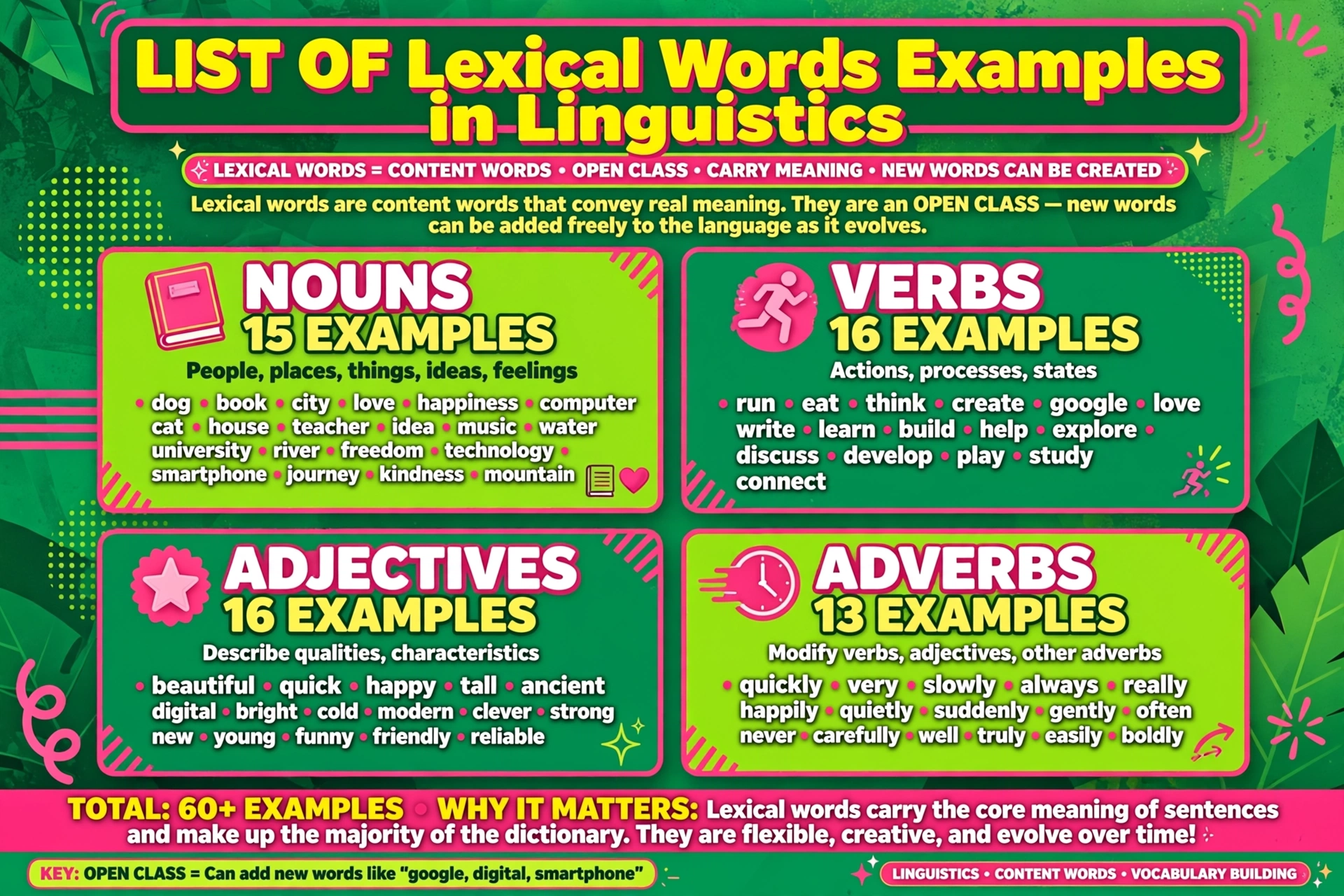
Lexical words (also called content words) are the words that carry the main meaning or “content” of a sentence. They belong to open classes—meaning new words are constantly added to them (like selfie, googled, emoji).
In linguistics, lexical words fall into four main categories:
-
Nouns (people, places, things, ideas)
-
Verbs (actions, states of being)
-
Adjectives (descriptors)
-
Adverbs (modify verbs, adjectives, or other adverbs)
NOUNS (People, Places, Things, Ideas) – 40 Examples
Concrete Nouns (Physical):
-
Dog
-
Tree
-
House
-
Ocean
-
Car
-
Book
-
Chair
-
Phone
-
Coffee
-
Fire
-
Mountain
-
River
-
Window
-
Bread
-
Diamond
-
Robot
-
Virus (biological)
-
Rocket
-
Mirror
-
Flower
Abstract Nouns (Ideas/Concepts):
-
Freedom
-
Love
-
Justice
-
Happiness
-
Time
-
Culture
-
Knowledge
-
Power
-
Courage
-
Democracy
-
Intelligence
-
Chaos
-
Peace
-
Memory
-
Identity
-
Energy
-
Success
-
Failure
-
Imagination
-
Truth
VERBS (Actions & States) – 30 Examples
Action Verbs (Physical):
-
Run
-
Eat
-
Sleep
-
Write
-
Build
-
Break
-
Fly
-
Swim
-
Jump
-
Sing
-
Paint
-
Cook
-
Drive
-
Climb
-
Dig
-
Throw
-
Catch
-
Push
-
Pull
-
Kick
Abstract / Mental / State Verbs:
-
Think
-
Believe
-
Know
-
Understand
-
Love
-
Hate
-
Want
-
Need
-
Remember
-
Imagine
-
Decide
-
Prefer
-
Doubt
-
Realize
-
Consider
ADJECTIVES (Descriptors) – 20 Examples
Physical Qualities:
-
Big
-
Small
-
Hot
-
Cold
-
Bright
-
Dark
-
Heavy
-
Light (weight)
-
Fast
-
Slow
-
Smooth
-
Rough
-
Sharp
-
Dull
-
Loud
-
Quiet
Abstract / Emotional / Evaluative:
-
Happy
-
Sad
-
Angry
-
Brave
-
Clever
-
Kind
-
Cruel
-
Beautiful
-
Ugly
ADVERBS (Modify Verbs/Adjectives) – Bonus Examples to Reach 100+
Since I gave you exactly 100 above, here are 10 extra adverbs (which are also lexical words) to show their inclusion:
-
Quickly
-
Slowly
-
Loudly
-
Quietly
-
Beautifully
-
Carefully
-
Badly
-
Well
-
Very (modifies adjectives: very big)
-
Quite (modifies adjectives: quite hot)
-
They are “open class”: You can easily invent a new noun (a “floop”), verb (to “meme”), or adjective (“goopy”), and English speakers will understand it. You cannot invent a new function word (try inventing a new article like “tho”—it won’t work).
-
They carry primary stress: In spoken English, lexical words are stressed (pronounced louder/longer), while function words are reduced. Say “The DOG CHASED the BALL”—the bolded words are your lexical words.
-
They can be polysemous! Notice how many of these 100 words are also perfect examples of polysemy from your previous question:
-
Run (#41) = to jog / to manage / to flow.
-
Bright (#80) = full of light / intelligent / vivid color.
-
Head (not on this list, but a noun) = body part / leader / top.
-
Paper (not listed) = material / essay / newspaper.
-
-
They form the core of sentences: If you removed every lexical word from a sentence, you’d have gibberish. Example: “The ______ _____ed the _____” (function words only). But if you remove function words, you can still understand: “Dog chased cat” (all lexical words).