Explore compelling examples of psycholinguistics research and discover how language shapes our thinking, behavior, and communication.The relationship between Psychology and linguistics is one of the important cornerstones in the implementation of education. Therefore, educators must know what to do to with students in every different stage of development.
Psychology focuses on understanding the human mind and behavior, employing methods like experiments and case studies, and has applications in various fields like therapy and education. In contrast, linguistics deals with the structure and use of language, relying on language analysis and fieldwork, and has applications in areas like language education and computational linguistics. Both fields have been shaped by influential theorists, such as Freud and Skinner in psychology, and Chomsky and Saussure in linguistics.
10 Psycholinguistics Examples In Real life You Must Know.
Here are real-life, everyday examples of psycholinguistic principles at work:
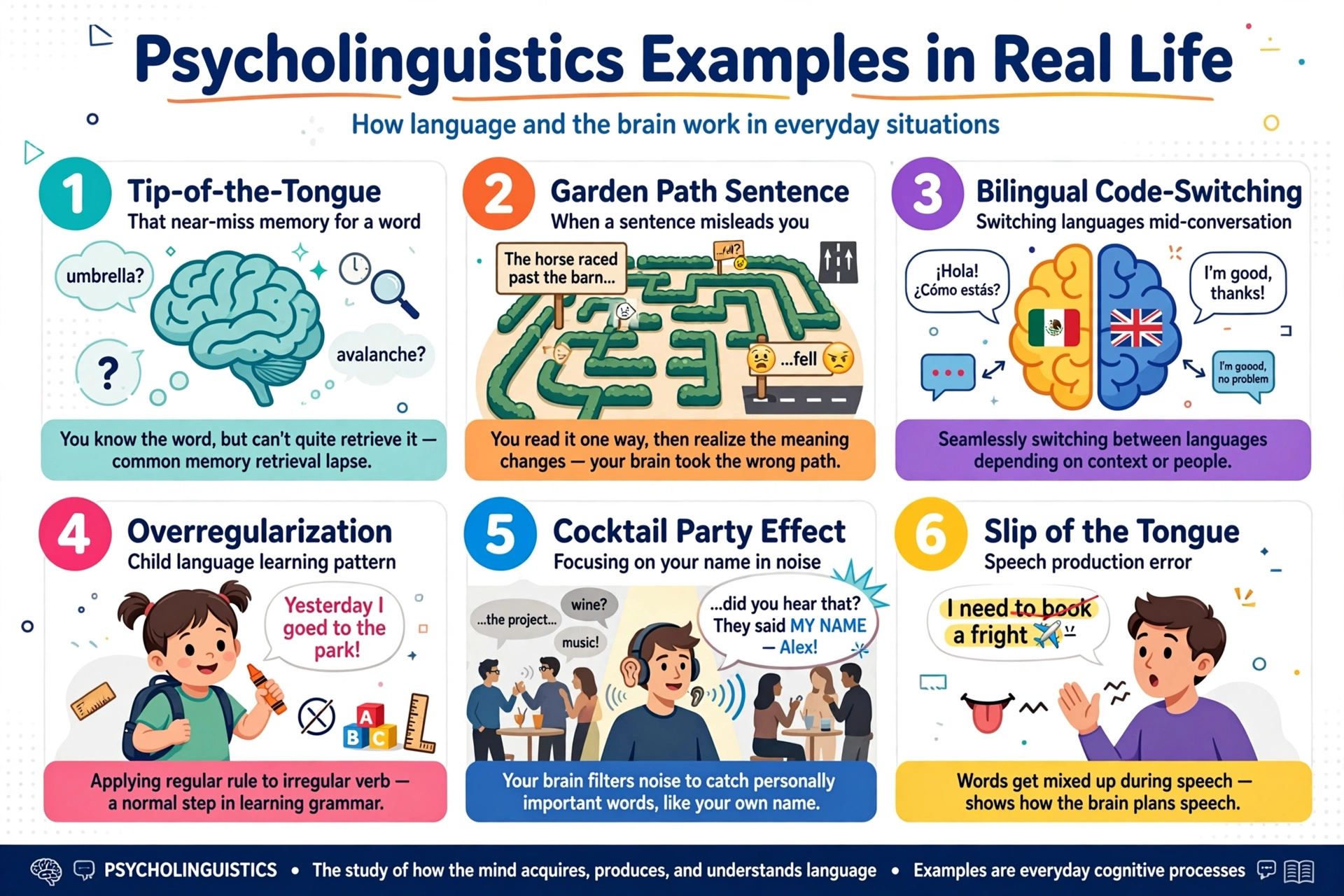
1. The “Cocktail Party Effect” (Speech Perception & Attention)
You are at a noisy party, surrounded by overlapping conversations and music. Somehow, you are able to tune out all the noise and focus entirely on what one person is saying to you. But the instant someone across the room says your name, your attention immediately snaps to that conversation.
The psycholinguistics: This proves that your brain processes the meaning and phonetics of background speech subconsciously, even when you aren’t paying attention. Your brain is constantly monitoring incoming audio for personally relevant triggers (like your name).
2. The Tip-of-the-Tongue Phenomenon (Lexical Retrieval)
You are trying to tell a friend about a movie, but you cannot remember the actor’s name. You know you know it. You can remember that it starts with an “M,” that he was in that action movie, and that it has three syllables, but the actual word just won’t come out.
The psycholinguistics: This happens when your brain successfully activates the semantic (meaning) and phonological (sound) networks for a word, but fails to fully activate the phonetic (motor) plan needed to actually speak it. Your brain finds the “file folder,” but temporarily can’t pull out the exact file.
3. Mishearing Song Lyrics (Mondegreens) (Top-Down Processing)
You sing along to a song, confidently belting out the wrong lyrics (e.g., Jimi Hendrix’s “‘Scuse me, while I kiss this guy” instead of “kiss the sky”). Even when you later learn the correct lyric, you still hear the wrong one.
The psycholinguistics: This is called top-down processing. Your brain doesn’t just process sounds from the bottom up (ears to brain). It actively predicts what it expects to hear based on context, your past experiences, and general knowledge. When the audio is unclear, your brain fills in the gaps with its “best guess,” overriding the actual acoustic signal.
4. Speech Errors (Spoonerisms) in Everyday Conversation (Language Production)
You are rushing to get out the door and accidentally say, “I need to make a flake,” instead of “I need to take a flake” (or “bake a cake”). Or you say, “You have a half-warmed fish” instead of a “half-formed wish.”
The psycholinguistics: These slips reveal that your brain plans sentences in chunks, not word-by-word. Before you even open your mouth, your brain has already sequenced the consonants, vowels, and grammatical structures for the entire phrase. A slip happens when these “planning units” get swapped around in your working memory during the rush to speak.
5. Understanding Incomplete Texts (Reading & Context)
You receive a text from a friend that says, “I’m at the…” and nothing else. You instantly know they probably meant, “I’m at the store,” “I’m at the cafe,” or “I’m at the bus stop” based on your prior conversation.
The psycholinguistics: This demonstrates syntactic priming and contextual integration. Your brain uses the surrounding context (your previous chat) and your knowledge of sentence structure (a prepositional phrase follows “at the”) to instantly predict and fill in missing grammatical information, allowing you to comprehend language even when it’s physically incomplete.
6. Ordering in a Fast-Food Drive-Thru (Working Memory & Parsing)
You hear the employee say, “Would you like fries with that?” You respond, “No, just the burger and a large drink.” As soon as the burger arrives, you realize you actually ordered a cheeseburger but you got a regular hamburger.
The psycholinguistics: You used working memory to hold the previous parts of the sentence while you processed the ending. As the sentence got longer, your working memory became overloaded, and you “parsed” (grammatically broke down) the meaning incorrectly under pressure, causing a comprehension error.
7. A Baby Pointing at a Dog (Language Acquisition)
A 14-month-old toddler sees a golden retriever and points at it. Their parent says, “That’s a dog!” Later, the toddler sees a tiny chihuahua and says “Dog!” Even later, they see a cat and say “Dog!”
The psycholinguistics: This illustrates overextension and semantic feature theory in language acquisition. The child initially learned the word “dog” by associating it with a set of features (four legs, fur, medium-to-large size). They haven’t yet learned the distinctive feature (bark vs. meow, snout shape), so their brain over-applies the label to anything that fits their current mental prototype.
8. Stuttering or Pausing before a Noun (Syntactic Planning)
While telling a story, you stop mid-sentence: “So I went to the… um… (long pause)… grocery store.” You don’t pause before verbs or adjectives nearly as often.
The psycholinguistics: Research shows that the brain does most of its heavy grammatical planning before producing nouns and verbs in a sentence. Long pauses and “ums” naturally occur right before we introduce new, complex, or less-predictable nouns into a conversation, because our brain is taking extra time to retrieve that specific lexical item from our mental dictionary.