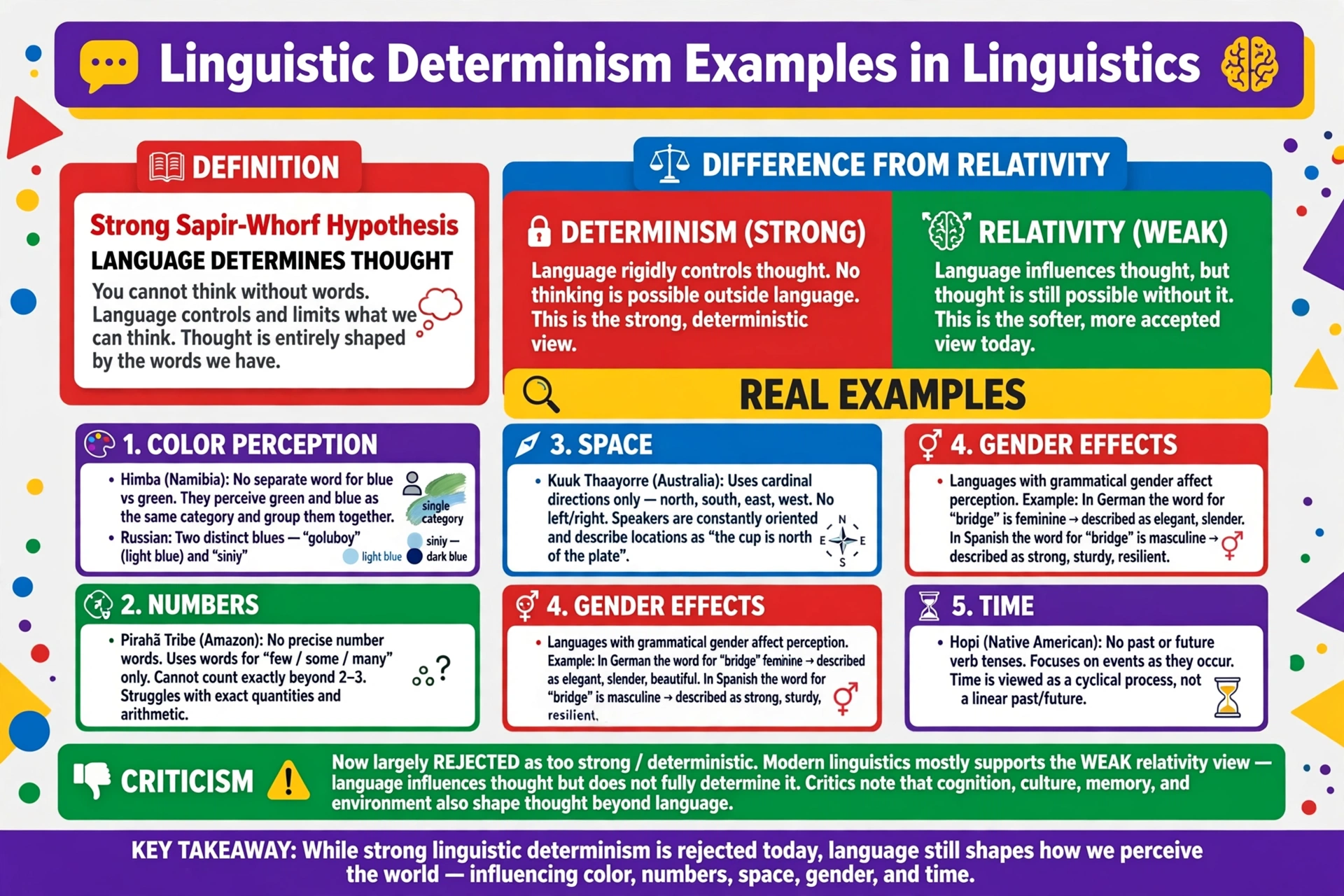
Explore examples of linguistic determinism in linguistics and discover how language can shape our thoughts and perceptions. Linguistic determinism says ” language determines the way the people think”. The language has always been a historical question that tells a challenge that does not understand in all prospective. It is the idea that language and its structures limit and determine the knowledge or human thought such as categorization, the memory (psychology) and perception.
Linguistic Determinism Examples In Linguistics.
According to the linguistic determinists our thinking (or ‘world view’) is determined by the language – with the use of the structures of grammar, semantics and ontology in language.
This theory states that it is not only our perception of the world that affects our language, but also the language we use it also can affect the way we think. Thus, we will be able to challenge and question the way the use of terms and viewpoints in a language. So the world we know is mainly determined by the language taught by our culture.
The main sticking point in the debate about the linguistic relativism is the problem of the correlation between language and thinking. The most severe form of linguistic determinism is a correlation, which suggests that language is completely, defines all the possible cognitive processes of the individual. Linguistic determinism is also sometimes described as “strict hypothesis Sapir-Whorf”, while the other forms of the proposed correlation is described as “soft hypothesis Sapir-Whorf.
Linguistic Determinism (also called the strong version of the Sapir-Whorf hypothesis) claims that language completely determines thought—meaning you cannot think, perceive, or conceptualize anything that your language does not have a word or grammatical structure for.
In modern cognitive science, this hypothesis is almost entirely rejected as false. No linguist or psychologist today believes language is a “prison” for the mind. However, to understand why it was rejected, linguists study hypothetical and historical examples that would prove determinism if they were true.
The Myths (and Why They’re False)
1. The Great Eskimo Snow Hoax
The Claim: Eskimos (Inuit) have dozens—some say over 50—distinct words for snow. Therefore, they perceive snow in ways we English speakers literally cannot fathom. An Inuit person sees wet snow, dry snow, falling snow, and packed snow as completely different things, not just variations of one substance.
The Reality: Complete myth.
Linguists later dug into this and found that Inuit languages have about as many snow-related roots as English does. We have snow, sleet, slush, blizzard, flurry, powder, drift. They have a similar number.
More importantly, Inuit speakers have a generic word for snow. They can absolutely think about “snow in general.” They aren’t walking around in a hyperspecific snow-reality. The myth was massively exaggerated by Benjamin Lee Whorf himself, and it has been thoroughly debunked.
2. The Color Blindness Myth
The Claim: The Dani people of Papua New Guinea only have words for “dark” and “light.” They have no words for specific colors like red, blue, or green. Therefore, according to determinism, they literally cannot see the difference between a red apple and a green leaf.
The Reality: Empirically false.
In the 1970s, cognitive scientist Eleanor Rosch ran a brilliant experiment. She showed the Dani a color palette and asked them to remember specific shades. Despite having no words for these colors, they remembered them perfectly. Their brains processed the visual information just like anyone else’s. They just didn’t have a convenient label for it.
Imagine you see a stranger’s face. You don’t have a specific word for their exact nose shape, but you can still recognize them tomorrow. Perception and language are not the same thing. Your eyes work fine without a dictionary.
3. The “No Future, No Savings” Theory
The Claim: This one pops up in finance blogs all the time. Some languages (like German, Japanese, and Finnish) don’t have a distinct future tense—they use the present tense plus context, like “I go tomorrow.”
The deterministic claim goes like this: Because these speakers don’t have a future tense, they perceive the future as closer to the present. Therefore, they save more money, exercise more, and eat healthier than English speakers.
The Reality: A statistical correlation, not determinism.
Yes, data shows that speakers of “futureless” languages tend to have higher savings rates. But does that mean a German person can’t think about the distant future? Of course not. Germans retire, plan vacations, and worry about climate change just like everyone else.
The correlation exists because grammatical habits subtly bias our attention, not because we’re cognitively locked in. If you grow up speaking a language that blurs present and future, you might feel a tiny psychological nudge toward long-term planning. But it’s a nudge, not a cage.
The “Almost” Examples (That Still Fail)
4. The Human Compass
The Claim: The Guugu Yimithirr people of Australia have no words for “left” or “right.” Instead, they use absolute cardinal directions for everything—even tiny objects. They would say, “The cup is south of the plate” rather than “The cup is to the left of the plate.”
Determinism says they must be incapable of understanding egocentric space (relative to their own body).
The Reality: They can learn left/right if taught.
The Guugu Yimithirr are absolutely brilliant at knowing which way north is at all times (even indoors or in the dark). But they aren’t imprisoned by their language. When researchers taught them the concepts of left and right, they understood them immediately. Their language habituates them to use compass points, but it doesn’t prevent them from using body-relative coordinates.
5. The Broken Vase Experiment
The Claim: English speakers say, “She broke the vase,” assigning agency and blame even for accidents. Spanish speakers say, “Se rompió el florero”—literally, “The vase broke itself.”
Determinism says Spanish speakers must be unable to assign blame or conceptualize intentionality.
The Reality: They can—they just don’t default to it.
In famous experiments, Spanish speakers were less likely to remember who broke the vase compared to English speakers. But when you directly ask them, “Who broke it?” they can absolutely point to the person. Language affects attention and memory recall, not moral reasoning itself.
The Ultimate Proof That Determinism is Dead
If linguistic determinism were true, then people who lose their language would lose their ability to think.
Enter aphasia. Aphasia is a condition caused by brain damage (usually a stroke) that destroys a person’s ability to process language. They cannot speak, cannot understand words, and often cannot read or write.
And yet…
People with severe aphasia can still:
-
Solve complex math problems
-
Play strategic chess games
-
Build furniture from IKEA instructions (using visual reasoning)
-
Fall in love
-
Make moral judgments
If language were the prison of thought, these patients would be vegetables. But they aren’t. Thought clearly exists independently of language.