Discover instructional design principles in enhancing the learning experience for students.Instructional Design (ID) is the systematic art and science of creating effective, engaging, and efficient learning experiences.It is the “architecture” of education. Just as an architect designs a blueprint for a building before construction starts, an instructional designer builds a blueprint for a course, lesson, or training program before the teacher ever steps into the classroom (or the learner logs into an app)
An instructor should be familiar with the broad objectives of the school before attempting to make
his course of study. The school administrators should be able to supply these objectives upon request..It is important for an instructor to know the broad objectives of the department in which he works.These should be determined before the more specific objectives of his own course are developed.
Instructional Design Principles.
To give you the complete picture, it helps to know that Instructional Design (ID) is the systematic process of creating educational experiences that make learning efficient, effective, and engaging.
Instead of just throwing information at students, ID principles ensure that every piece of content, activity, and assessment serves a clear purpose.
Here is the complete, master list of the most important Instructional Design principles, broken down by the major learning theories that dominate the field today.
These are the non-negotiable core principles that apply to any ID model you use:
-
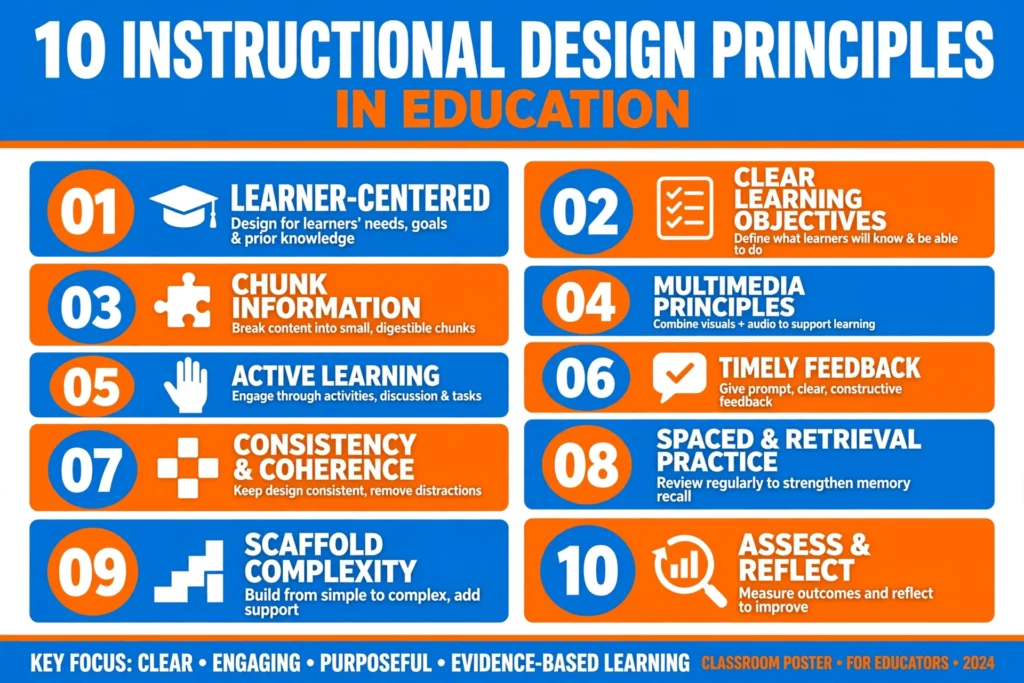
Learner-Centeredness: Start with the learner, not the content. You must know their prior knowledge, age, motivations, cultural background, and digital literacy before you design a single slide.
-
Goal-Oriented (Alignment): Every single element of your course (videos, readings, quizzes) must directly tie back to a clear, measurable learning objective. If it doesn’t help the learner achieve the goal, cut it out.
-
Active Engagement: Learning is not a spectator sport. Learners must manipulate information, solve problems, discuss, or create something to truly learn (moving beyond passive listening or reading).
-
Scaffolding: Break complex skills into smaller, manageable “chunks.” Provide heavy support (step-by-step guides) at the beginning, and gradually remove that support as the learner gains confidence (this is called “fading”).
-
Feedback & Iteration: Learning requires timely, specific, and non-judgmental feedback. Learners need to know why they got an answer wrong and how to improve, not just “Correct” or “Incorrect.”
Every ID principle stems from one of three psychological theories. Here is how they translate into action:
A. Behaviorist Principles (Drill, Practice, and Reinforcement)
Focus on observable changes in behavior through stimulus and response.
-
Reinforcement: Positive outcomes (praise, badges, points) should immediately follow correct behaviors to strengthen them.
-
Repetition & Practice: Spaced repetition (reviewing material at increasing intervals) is essential for moving facts into long-term memory.
-
Shaping: Reward small successes along the way to a larger goal (e.g., give a badge for completing a single module, not just the final exam).
B. Cognitivist Principles (Information Processing & Memory)
Focus on how the brain takes in, organizes, stores, and retrieves information.
-
Dual Coding: Present information using both words and visuals simultaneously (e.g., narrating over an animation) to build two mental pathways, which doubles retention.
-
Chunking: The brain’s working memory can only hold 4–7 pieces of information at once. Break content into tiny, digestible “chunks” (usually 5-10 minutes per topic).
-
Advance Organizers: Give learners a “big picture” roadmap or outline before diving into the details, so they have a mental framework to attach new facts to.
-
Meaningful Learning: Connect new information to real-world scenarios or things the learner already knows (e.g., teaching fractions using pizza slices).
C. Constructivist Principles (Active Meaning-Making)
Focus on learners building their own understanding through experience and reflection.
-
Problem-Centered: Present a real-world, messy problem at the start of a lesson, rather than giving the solution first. Let learners struggle productively to find a solution.
-
Social Collaboration: Knowledge is built through discussion. Design peer-to-peer activities, group projects, and debate forums.
-
Authentic Tasks: Assessments should mirror real-world tasks (e.g., a marketing student creates an actual ad campaign, not just a multiple-choice test about marketing).
-
Reflection: Build in time for learners to pause and think about how they learned (metacognition), not just what they learned.
With the rise of eLearning, instructional designers have added these modern, tech-focused principles:
-
Multimedia Principle (Mayer): People learn better from words and pictures than from words alone. But… remove all extraneous, “decorative” images—they just distract the brain.
-
Modality Principle: People learn better from a narrated animation than from an on-screen text animation (because visuals + audio use separate brain channels, but visuals + text overload the eye channel).
-
Personalization Principle: Use a conversational, informal tone (using “you” and “I”) rather than a formal, robotic academic tone. It activates the brain’s social receptors and increases focus.
-
Microlearning: Deliver content in short, focused bursts (2–7 minutes) specifically designed for mobile consumption and “just-in-time” performance support.
-
Accessibility (UDL – Universal Design for Learning): Design for all learners from the start. Provide alt-text for images, closed captions for videos, and allow multiple ways for students to demonstrate their knowledge (type, speak, or draw).