
Learn about the composition of cow milk and why it is important for your health. Explore the key nutrients found in cow milk and their benefits.Cow milk is one of the most nutrient-dense foods available. But what exactly is in it? This article breaks down the composition of cow milk — from water and fat to protein, lactose, minerals, and vitamins — and explains how these components vary based on breed, diet, and season.
The Basics:Cow Milk Composition.
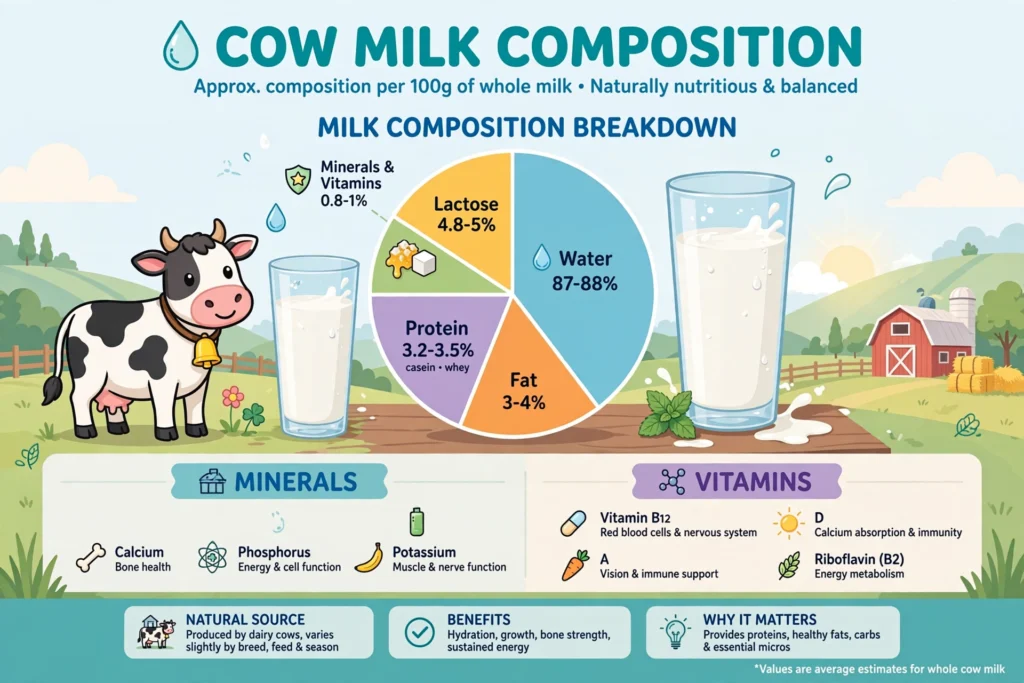
Milk is primarily water, making up about 87–88% of its total volume. The remaining 12–13% consists of solids — the components that give milk its nutritional value and functional properties.
The typical composition of cow milk looks like this:
| Component | Percentage |
|---|---|
| Water | 87–88% |
| Fat | 3–4% |
| Protein | ~3.5% |
| Lactose | ~5% |
| Minerals | ~0.7% |
| Vitamins | Trace amounts |
This general profile holds true across most dairy cattle, but the exact numbers shift depending on several factors we’ll explore later.
Fatty Acid Profile
The fatty acid makeup of cow milk is distinct among food fats. The predominant saturated fatty acids are myristic, palmitic, and stearic acids, accounting for roughly 75% of total fatty acids. Monounsaturated fatty acids make up about 21%, with oleic acid being the most abundant. Polyunsaturated fatty acids are relatively scarce — only about 4% of total milk fat, mainly as linoleic and linolenic acids.
What truly sets cow milk apart is its content of short-chain fatty acids (C4:0 to C10:0). These are synthesized in the mammary gland and are rare in other common dietary fats. They contribute to milk’s characteristic flavor and are metabolized differently than long-chain fats.
Factors That Change Milk Composition
Cow milk is not a fixed formula. Its composition shifts in response to several biological and environmental factors.
Breed
Different cattle breeds produce milk with distinct characteristics. Bos indicus cattle (such as Zebu breeds) generally have higher fat content than Bos taurus breeds — up to 5.5% fat compared to the typical 3–4%. Within B. taurus breeds, Jersey cows are known for producing milk with higher fat and protein percentages than Holsteins.
Diet
What a cow eats directly influences her milk. When cows graze on fresh pasture, their milk contains higher levels of omega-3 fatty acids, conjugated linoleic acid (CLA), and vaccenic acid compared to cows fed conserved forages or grain-heavy diets. A 10 percentage-point increase in herbage proportion in the diet leads to measurable increases in these beneficial fatty acids.
Stage of Lactation
Milk composition changes over the course of a lactation cycle. Early-lactation milk (colostrum) is rich in immunoglobulins and other bioactive compounds. As lactation progresses, fat and protein percentages typically follow an inverse relationship with milk yield — they dip at peak production and gradually rise again toward the end of lactation.
Season
Seasonal variation in milk composition reflects changes in available feed. Studies have documented that fat percentages tend to be lower in summer than winter, while protein percentages show less consistent seasonal patterns. For grazing herds, the shift from pasture to indoor feeding in winter produces detectable changes in fatty acid profiles.
Cow milk is a complex biological fluid with a composition shaped by genetics, diet, environment, and evolution. Its roughly 87% water content carries a dense payload of fat, protein, lactose, minerals, and vitamins — each component contributing to milk’s role as a nutritional powerhouse.
Understanding milk composition helps explain why dairy products behave the way they do in cooking, why some people digest milk more easily than others, and why the same glass of milk can vary in flavor and nutritional profile depending on where and when it was produced. Whether you are a consumer, a chef, or simply curious about what you drink, the composition of cow milk offers a fascinating window into one of nature’s most complete foods.


