Learn about the key pedagogical principles in teaching and how they can guide educators in creating engaging and impactful learning environments for students.
12 Pedagogical Principles In Teaching You Must Know.
- The teacher motivates the students’ in the class and that makes everybody interested in the process of teaching- learning through motivation, the teacher becomes a source of joy for the learners. When the students-are interested in the teacher, they also like his activity of teaching.’
- A good teacher is not always busy in just, finishing the prescribed course of study. He repeats matter and also gives sufficient: practice so that it is fully understood by them.
- Feedback and reinforcement are very important in ‘the process of teaching-learning. If a test is held, the teacher should tell the students about their results as early as possible. Immediate feedback helps them to learn more.
- The teacher should keep in mind the principle of Variety. A good teacher uses different methods of teaching and that keeps the students fully interested in the process of teaching-learning.
- The principle of rest and recreation changes the attitude of the teacher. So a teacher while teaching takes care of the fact that the students have some rest in between. He also recreates them. All this helps the teacher to teach better and the learner is also able to learn more.
- A good teacher prepares the students first for his teaching .and then only he starts teaching. This is bound to improve teaching-learning.
- Creative teaching is good. The teacher should teach in such a way as the learners become creative.
- A sympathetic type of teacher is able to win the hearts of the learners. The teacher should always be co-operative with the students. Let co-operation flow from the teacher first. That will make the whole teaching-learning quite effective.
- The teacher should not do spoon feeding. He should arouse their interest and develop in them love for self-learning. This practice reduces the load of work of the teacher. The student is also able to learn really.
- While teaching a group, the teacher should keep in mind the group behavior of learners. Then only he will be able to teach well.
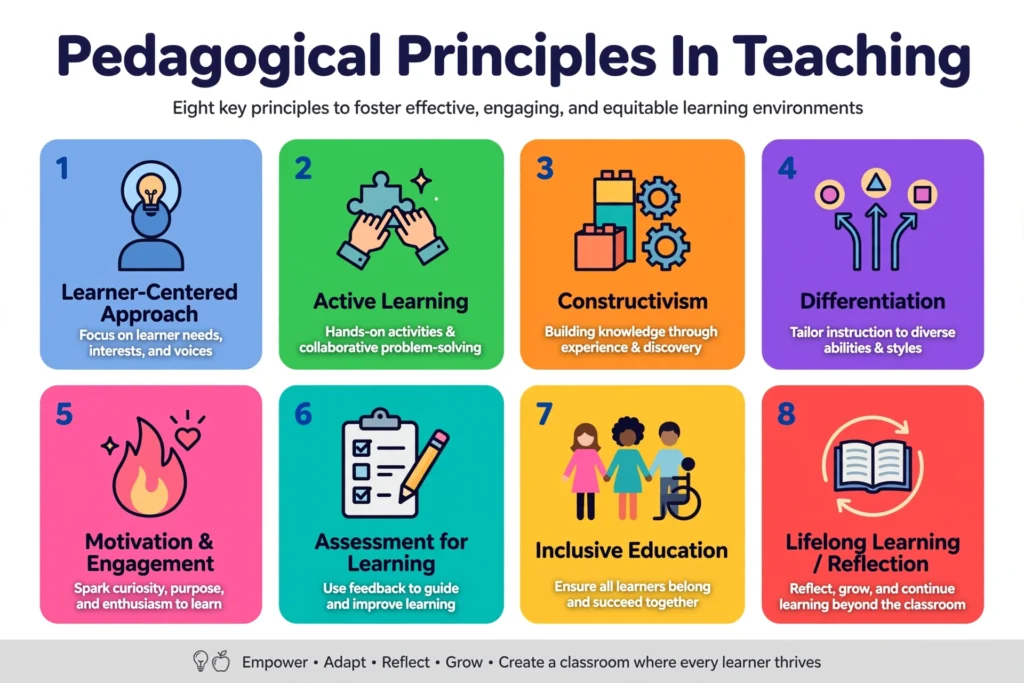
Active and Constructive Learning
This principle moves beyond passive listening and rote memorization to engage students in constructing their own understanding.
-
Experiential and Hands-on: Learning should involve direct experience, experimentation, and “doing”.
-
Collaborative: Students learn through cooperation, peer interaction, and group work.
-
Multisensory: Using a variety of senses (visual, auditory, kinesthetic) makes learning more effective and enjoyable.
Creating a Supportive and Respectful Environment
A positive classroom climate is essential for learning.
-
Positive Relationships: Foster strong, respectful relationships between the teacher and students, and among peers.
-
Safety and Inclusion: Create a safe space where all students feel valued, respected, and confident to take risks in their learning.
-
Valuing Diversity: Recognize and accommodate diverse backgrounds, learning styles, and abilities
Principles of teaching are undoubtedly effective tools in the hands of a teacher. Only a good teacher is able to put them to right use. The saying that a bad workman quarrels with his tools is perfectly true. The different principles Of teaching can work wonders in the hands of a good teacher. The teachers under training are, therefore, advised to keep the principals of leaching in mind .while teaching. He is bound to make them better and better teachers in due course of time.