
Pharmacogenetic examples demonstrate the impact of genetics on personalized medicine. Explore real-life scenarios where genetic testing guides medication therapy for optimal outcomes.
Pharmacogenetics is concerned with those deviant responses to specific drugs that are genetically determined.It has long been recognized that certain people react unusually to the administration of drugs. In some instances the altered reaction has an immunologic basis; in others it appears to be idiosyncratic without any obvious cause; and in some the difference appears to be contingent on genetic variations of the host. The breakdown and disposal of drugs in the body are usually dependent on a series of specific gene- controlled enzymatic reactions. Mutant genes in the population that alter these reactions by mutation can result in serious clinical consequences.
Inherited Diseases Discovered or Precipitated by the Use of Drugs. A number of diseases have been disclosed or precipitated as a direct result of the development of drugs which for their proper metabolic disposal require an intact enzyme system. In the absence of the additional pharmacologic overload, the defective enzyme system does not cause disease.
Glucose-6-Phosphate Dehydrogenase Deficiency. A severe hemolytic anemia may be produced by the ingestion of the broad bean Vicia fava. The anemia is due to deficiency of the X-linked enzyme about 0.5 per cent) and q is the abnormal gene.
Let us suppose a recessively inherited disease has a frequency in the population of 1 in 10,000 (q2); then the frequency of the gene which in double dose causes the disease 1 uni 100 (q). If the frequency of consanguinity in the general population is 0.5 percent, then the k frequency of cousin marriages, in the percent, a sixfold increase over normal disease is much rarer, 1 in 100.000. then 10 cent of the individuals affected by the diseases will have parents who are first cousins. As time frequency of c increases, the expected frequency of parents who are first cousins will also increase. ln some geographically isolated populations c may reach 2 per cent.
Here is a list of clinically relevant pharmacogenetic examples, paired with findings from the latest research that highlight the progress and future direction of the field.
Key Pharmacogenetic Examples and Latest Research.
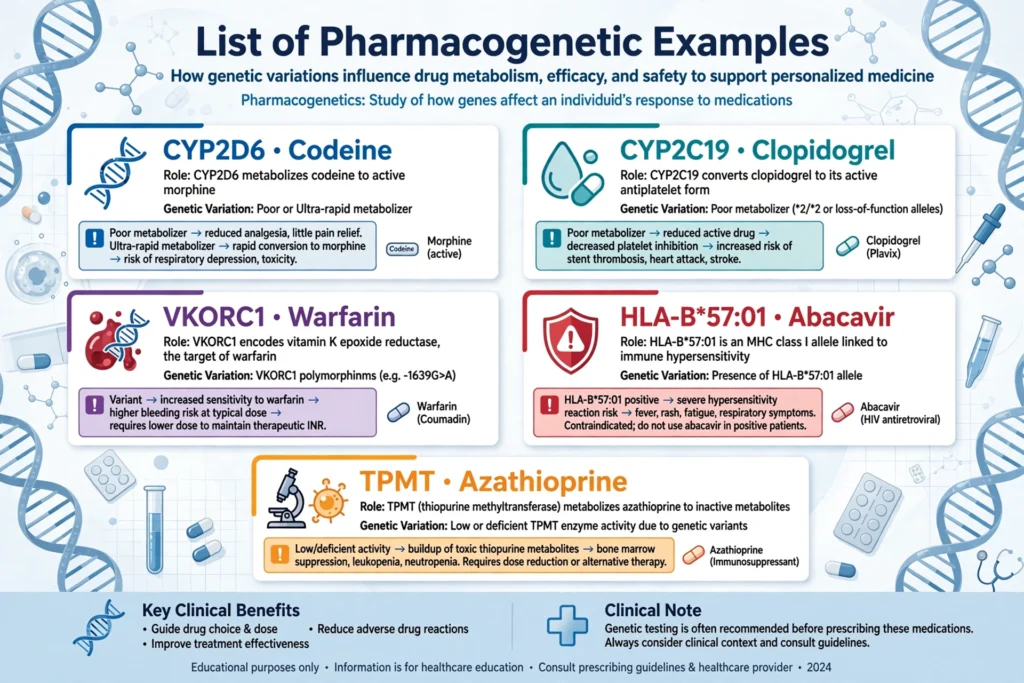
Here is a list of clinically relevant pharmacogenetic examples, paired with findings from the latest research that highlight the progress and future direction of the field.
| Gene(s) & Drug(s) | Clinical Relevance |
|---|---|
| CYP2C19 & Clopidogrel | Effectiveness. CYP2C19 metabolizes the prodrug clopidogrel to its active form. Poor metabolizers have a higher risk of cardiovascular events. |
| VKORC1/CYP2C9 & Warfarin | Dosing. Variants affect the drug’s target (VKORC1) and its metabolism (CYP2C9). Knowing the genotype helps determine the optimal starting dose. |
| SLCO1B1 & Simvastatin | Toxicity. A low-function SLCO1B1 variant increases the risk of statin-induced myopathy. Consider a lower dose or alternative statin. |
| TPMT & Azathioprine | Toxicity. Patients with reduced TPMT enzyme activity are at a high risk of severe myelosuppression. Testing helps guide dosing. |
| HLA-B*57:01 & Abacavir | Hypersensitivity. Carrying this allele carries a near 100% risk of a severe, potentially fatal hypersensitivity reaction. Testing is mandatory before use. |
| CYP2D6 & Codeine | Effectiveness/Toxicity. Poor metabolizers get no pain relief, while ultrarapid metabolizers are at risk of opioid toxicity. |
| DPYD & 5-Fluorouracil | Toxicity. Variants in DPYD can cause severe, life-threatening toxicity from this common chemotherapy drug. |
Latest Research Highlights
The field of pharmacogenomics is rapidly advancing, with several key trends emerging from recent studies:
1. Unlocking Complex Genetics with New Technology.
A major breakthrough is the use of long-read sequencing technology. Traditional methods often struggle with complex genes like CYP2D6. Recent research shows that long-read sequencing can resolve these complex regions with high accuracy, identifying 19 novel star (*) alleles and 106 novel suballeles in key pharmacogenes like CYP2D6, CYP2C9, and SLCO1B1. This leads to more precise predictions of drug response .
2. Expanding Knowledge and Patient Populations.
Pharmacogenomic research is expanding into new populations and therapeutic areas:
-
New Drug-Gene Interactions: A 2025 study highlighted that a high percentage of patients are on pharmacogenetic (PGx) drugs, with bisoprolol, aspirin, losartan, indapamide, and omeprazole being among the top five commonly prescribed PGx drugs .
-
Population-Specific Insights: Research on an Indian cohort with familial hypercholesterolemia found that a high number of patients had variants in the APOB gene, unlike Western populations where LDLR mutations are more common. This emphasizes the need for population-specific pharmacogenetic data to personalize statin therapy effectively .
-
New Areas of Study: A 2026 study investigating patients with Prader-Willi syndrome (PWS) found significant differences in the frequencies of reduced-function CYP2B6 and CYP2D6 alleles. This suggests pharmacogenetic testing could be valuable for managing psychiatric medications in this population .



