
Ferber method sleep training can be an effective way to help your baby develop healthy sleep habits and learn to fall asleep independently. However, it is essential to consider your baby’s individual needs and consult with your pediatrician before starting any sleep training method.
The Ferber method, also known as “graduated extinction” or “Ferberizing,” is one of the most researched and widely used sleep training techniques for babies. Developed by Dr. Richard Ferber in the 1980s, it aims to teach babies to fall asleep independently — without needing a parent to rock, nurse, or hold them.The Ferber Method (Graduated Extinction) allows parents to return for brief check-ins at gradually increasing time intervals. You comfort your baby verbally or with a gentle pat, but you do not pick them up. Then you leave again.
What the Research Says
Effectiveness.
A systematic review of randomized controlled trials found that graduated extinction is effective for children from 6 months of age. Benefits include:
-
Faster sleep onset
-
Fewer night wakings
-
Shorter night waking durations
-
Reduced bedtime resistance
Results are typically seen within a few days to two weeks and can be maintained at a 1-year follow-up.
A broader review of behavioral sleep interventions found that 94% of studies reported significant improvements in infant sleep problems, with over 80% of children showing clinically meaningful improvement.
Safety.
A five-year follow-up study examined whether sleep training harms the parent-child relationship. The findings were reassuring:
-
No negative effects on parent-child attachment
-
No negative effects on emotional development
-
Improved parental mood and reduced family stress
Research on cortisol (the stress hormone) found that infants undergoing graduated extinction did not show elevated stress levels that would indicate long-term harm. In fact, some studies showed mild to moderate decreases in cortisol as sleep improved.
The American Academy of Pediatrics states that allowing a baby to cry to sleep is safe and will not cause harm.
How to Do Ferber Method Sleep Training: Step by Step.
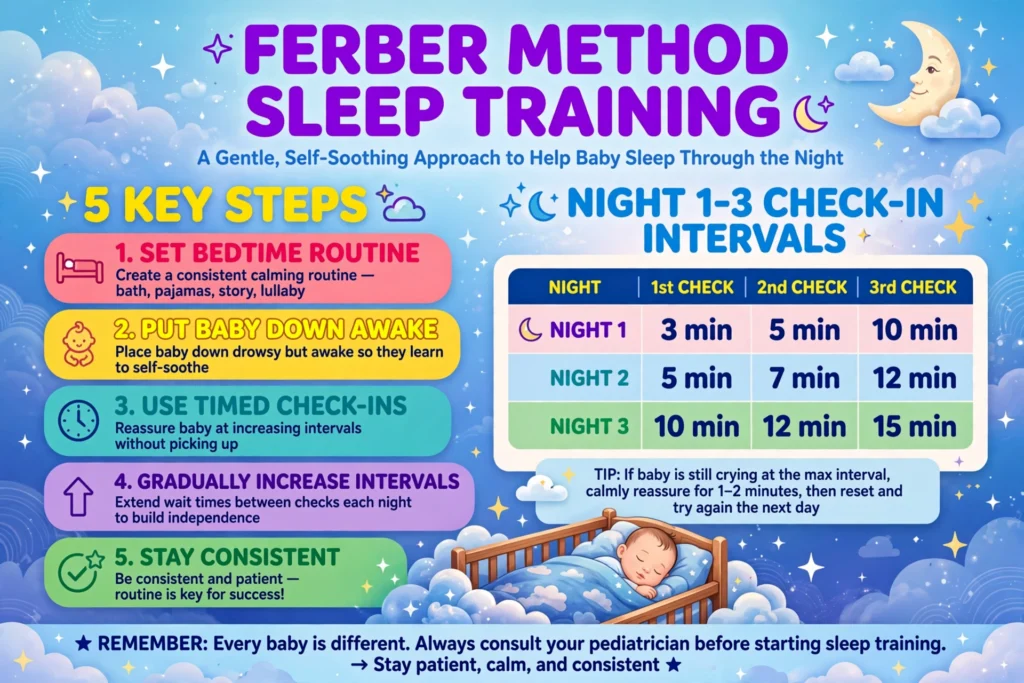
Step 1: Establish a Consistent Bedtime Routine
Create a calm, predictable routine every night. For example:
-
Bath
-
diaper change and pajamas
-
Feed (if applicable)
-
Book or song
-
Lights out
The routine should be the same every night so your baby learns what comes next.
Step 2: Put Baby Down Drowsy but Awake
After the routine, place your baby in the crib while they are sleepy but still awake. Say goodnight and leave the room.
Step 3: Wait Before Checking In
If your baby cries, wait for a set period before going back in. The waiting time starts short and increases over the night and over subsequent nights.
Step 4: Brief Check-Ins Only
When you check in:
-
Keep the visit under 1 minute
-
Do not turn on lights
-
Do not pick your baby up
-
Use a calm voice, shushing, or a gentle pat
-
Then leave the room again
The goal is to reassure your baby that you are nearby, not to soothe them to sleep.
Step 5: Extend the Intervals Each Night
Here is a sample schedule. Different experts recommend slightly different times, so adjust based on your comfort and your baby’s needs:
| Night | First Check | Second Check | Third Check | Later Checks |
|---|---|---|---|---|
| Night 1 | 3 minutes | 5 minutes | 10 minutes | 10 minutes |
| Night 2 | 5 minutes | 10 minutes | 12 minutes | 12 minutes |
| Night 3 | 10 minutes | 12 minutes | 15 minutes | 15 minutes |
| Night 4+ | Add 2–5 minutes to each interval |
Dr. Ferber himself emphasized flexibility. Some experts recommend keeping intervals under 10 minutes, while others allow up to 15 minutes or more.
Step 6: Handle Night Wakings the Same Way
If your baby wakes in the middle of the night and cries, follow the same check-in schedule. If your baby still needs night feedings, continue to feed at set times. Outside those times, use the Ferber intervals.
When to Start (and When Not To)
Age
Most experts recommend starting no earlier than 4 to 6 months, with 6 months being the most common recommendation. Before 4 months, babies are not developmentally ready to self-soothe and may still need frequent night feedings.
When to Avoid Sleep Training
Do not start the Ferber method if:
-
Your baby is sick
-
Your baby is teething
-
You are going through major changes (moving, starting daycare)
-
Your baby has a medical or sleep condition
-
You are not comfortable with the method
Always consult your pediatrician before starting any sleep training program.
Common Challenges
1. It’s Hard to Hear Your Baby Cry
This is the biggest barrier for most parents. The Cleveland Clinic notes that you “must train yourself not to respond immediately to those cries — which can be really, really hard.”
Dropout rates for the Ferber method range from 3% to 16%, mostly because parents cannot tolerate the crying.
2. Progress Is Not Always Linear
Babies may improve for a few nights and then regress during teething, illness, or developmental leaps. You may need to re-establish the routine after setbacks.
3. It May Not Be the Most Effective Method for Every Family
Some research suggests that graduated extinction is not more effective than gentler methods, such as the chair method or bedtime fading. The best method is the one you can consistently follow.


