Explore an example of semantics in linguistics to understand how meaning is constructed in language. Discover the role of semantics in interpreting words and phrases.However, meaning in linguistics isn’t just about dictionary definitions. It’s about how words combine, how context shifts meaning, and how sentences relate to reality.
The study of issue of meaning and its manifestation in language is normally referred to as Semantic In Linguistics. The term semantics as ‘relating to signification or meaning’/Broadly speaking, semantics is that aspect of ’ linguistics which deals with the relations between referents (names) and referents (things. that is, known as five linguistic levels and the objects-or concepts or-ideas to which they refer—and with the history and changes in the meaning of words,) Diachronic semantics which is also called historical linguistics studies semantic change over time scientifically we can say its shift and change of language across time.
Example of Semantics In Linguistics.
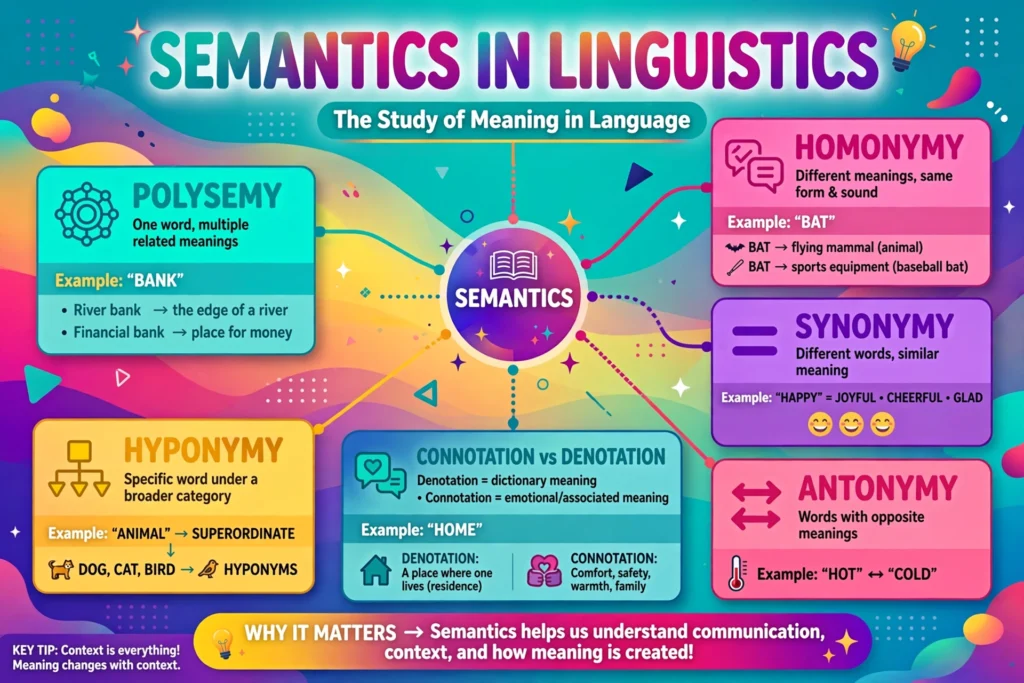
To better understand how semantics works in linguistics, let’s look at an example. Consider the sentence “The cat sat on the mat.” In this sentence, each word has a specific meaning, and the arrangement of the words conveys a particular message. The word “cat” refers to a small, domesticated feline animal, while “sat” indicates the action of sitting. The preposition “on” denotes the relationship between the cat and the mat, and “mat” refers to a flat piece of material for sitting or standing on.When we put all these words together in a specific order, we can derive the meaning of the sentence: a cat performed the action of sitting on a mat. Through semantics, we can understand the meaning of each word in the sentence and how they combine to create a coherent message.
However, meaning in linguistics isn’t just about dictionary definitions. It’s about how words combine, how context shifts meaning, and how sentences relate to reality.
Here is a clear, layered example using a single, very common word: “Bachelor.”
Layer 1: Lexical Semantics (Word Meaning)
Lexical semantics looks at the inherent meaning of a word and its features.
-
The literal features of the word bachelor are: [HUMAN] + [MALE] + [ADULT] + [UNMARRIED].
-
Using these features, a linguist can create a truth test: If a person is a 30-year-old unmarried man, the sentence “He is a bachelor” is TRUE.
-
The Flaw: What about the Pope? He is male, adult, and unmarried. But we don’t call him a bachelor. Why? Because the Pope is bound by a vow of celibacy. This introduces a semantic feature called [±marriageable]. The Pope is [-marriageable], so the word bachelor doesn’t apply.
Layer 2: Sense vs. Reference (The Same Word, Different Realities)
Semantics distinguishes between the sense (the mental concept) and the reference (the actual thing in the world).
-
Example: Consider the phrases “The Morning Star” and “The Evening Star.”
-
Sense: They have different senses (one appears at dawn, one at dusk).
-
Reference: They have the exact same reference (they both refer to the planet Venus).
-
Semantic takeaway: You can know what both phrases mean (sense) without knowing they point to the same physical object (reference).
Layer 3: Componential Analysis (Breaking Down Verbs)
Semantics doesn’t just apply to nouns; it applies to actions, too. Let’s compare the verbs “Kill” and “Murder.”
-
Kill = [CAUSE] + [BECOME] + [DEAD].
-
Murder = [CAUSE] + [BECOME] + [DEAD] + [ILLEGAL] + [INTENTIONAL].
In a sentence:
-
“The lightning killed the tree.” (Semantically correct).
-
“The lightning murdered the tree.” (Semantically anomalous—nonsense—because lightning lacks the semantic feature of [INTENTIONAL] and [ILLEGAL] cannot apply to weather).
Layer 4: Thematic Roles (Who did what to whom?)
Semantics assigns “roles” to nouns in a sentence to explain their relationship to the verb. Look at this sentence:
“John opened the door with the key.”
-
John = The Agent (the intentional doer of the action).
-
The door = The Patient (the entity that undergoes the action or changes state).
-
The key = The Instrument (the tool used to perform the action).
The semantic twist: If I change the sentence to “The key opened the door,” key shifts from being the Instrument to being the Agent (even though a key isn’t alive). Semantically, we now interpret this sentence as “The key did it by itself,” which is a different meaning entirely, even though the words are almost the same.
Layer 5: Entailment and Presupposition (Hidden Meaning)
Semantics studies what a sentence guarantees to be true versus what it assumes to be true.
Sentence A: “Jane stopped smoking.”
-
Presupposition (what the sentence takes for granted): Jane used to smoke. (This remains true even if you negate the sentence: “Jane did NOT stop smoking” still presupposes she used to smoke.)
-
Entailment (what logically follows): Jane is no longer smoking.
Layer 6: Ambiguity (The Ultimate Semantics Problem)
This is the most famous example in semantics, showing how a single sentence can have two entirely different logical meanings:
“The chicken is ready to eat.”
-
Meaning A: The chicken (the animal) is hungry and ready to be fed.
-
Meaning B: The chicken (the cooked meat) is cooked and ready to be consumed.
Semanticists use this to prove that our brains don’t just look at words—they use selectional restrictions (the noun chicken can mean an animal or a food) to decide the meaning based on context.
The Ultimate Example: Putting It All Together
Take the sentence:
“The old man’s glasses were found on the table.”
A semanticist analyzes this by saying:
-
Lexically: Glasses has two senses (eyewear vs. drinking containers).
-
Thematically: The table is the Location. The glasses are the Theme (the object being located).
-
Pragmatics/Semantics overlap: Does “found” imply that someone lost them (presupposition)? Does it imply that someone now has them (entailment)?
-
Truth conditions: If they were drinking glasses, the sentence is true only if they were on the table. If they were eyeglasses, the same physical situation applies, but the semantic interpretation of the word glasses changes entirely.
The example of semantics in linguistics provided here showcases the intricate interplay between words, meanings, and context in language. Next time you read or hear a sentence, consider the semantics at play and how it influences your understanding.