
Discover the Elizabethan Theater Facts and its impact on English history. Elizabethan theatre was a vibrant and influential cultural phenomenon that flourished in England during the reign of Queen Elizabeth I (1558–1603) . Here are some key facts about this fascinating period in theatre history
The Elizabethan theater were primitive concerns, large wooden sheds, partly cover of roof with material and rushes, a flagpole on the roof, and enclosed by a long, narrow ditch. They gave rise to a good deal of vexation to quiet citizens in the neighborhood. Around these play-houses in the afternoons, the narrow winding streets were so crowded by noisy, frivolous groups of people that business suffered in the shops, processions and funerals were thwarted, and continuous causes of complaint happened.
In spite of objections by the residents and the Puritans, theater multiplied rapidly. In 1633 there were nineteen permanent theaters in London which for a town of 300,000 inhabitants sufficiently indicate the keen interest taken in the drama.
Two Types of Theaters:
The private theaters were designed on the model of the Guild Halls ; These were were more comfortable, being fully decorated, ornamented and seated. In the public theaters, the auditorium, as in ancient Greece, was open to the sky, only the stage being roofed but not being seated. Thus the pleasure of seeing the play in the bad weather was marred.
There were no tickets. An amount of five pence in modem reckoning admitted a customer to standing room in the yard.
Rich spectators watched the performances from boxes on each side of the stage, paying about twelve shillings for the privilege (VIP) of a seat. In an upper box was the orchestra of the Globe theater, the largest in London, composed of ten performers with different instruments.
The fashionable part of the house was on the stage itself. There sat the royal families of the Essex and Southampton, with their friends and relatives.. Most important of all from our point of were the shorthand writers, in the pay of piratical booksellers, o took down the dialogue, under presence of criticizing it, and is preserved for posterity many play that otherwise would have been lost. There was a perpetual chatter of conversation between the fashionable spectators on the stage, interspersed with calls for drinks, and lights for their pipes. Smoking went on throughout the performance. The actors and the audience, however, accepted these interruptions without much protest.
You Must Know Elizabethan Theater Facts In Shakespearean Times.
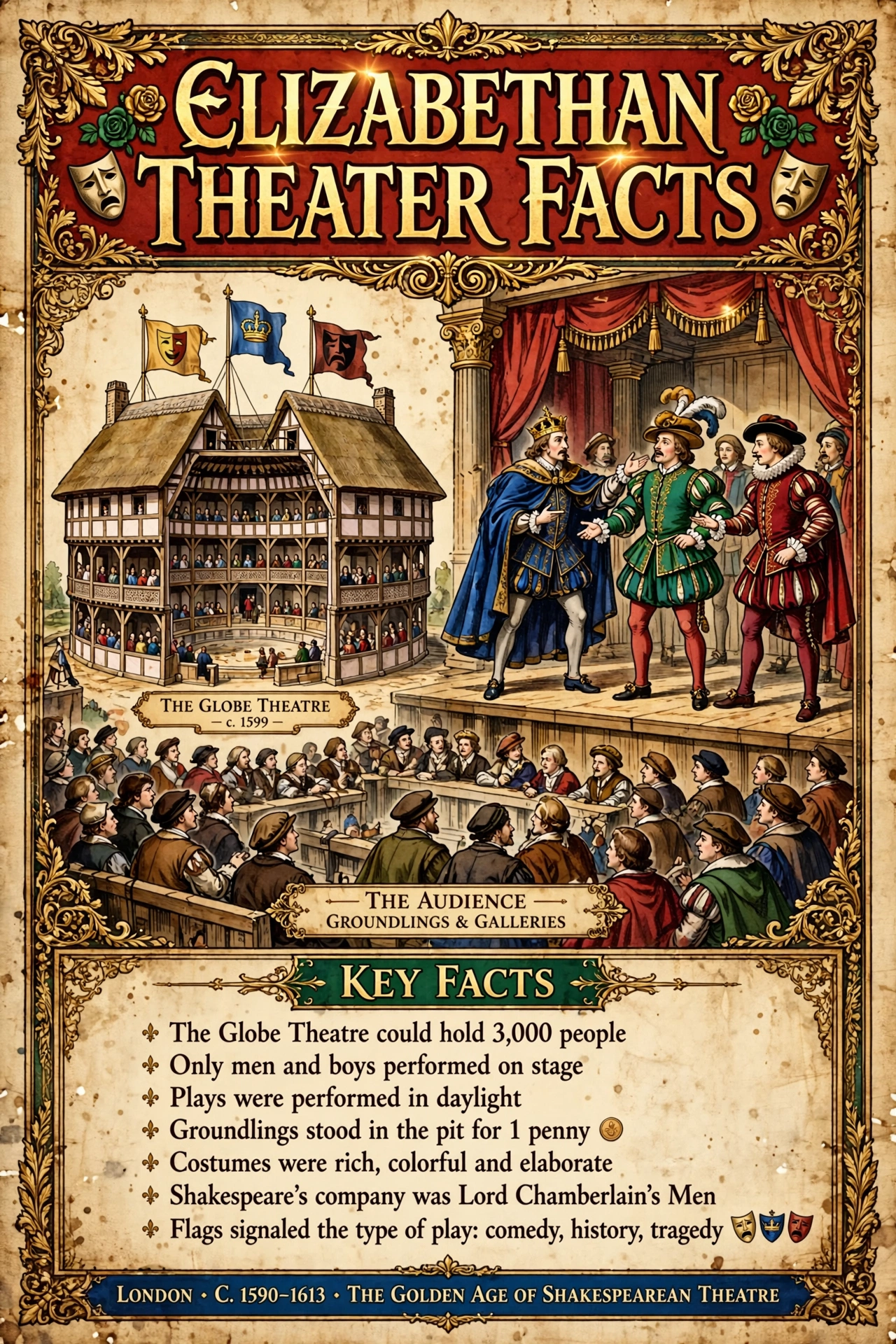
A trumpet-blast started the performance. Then came the prologue, spoken by an actor in a long black coat. The performance of a tragedy was signalized by draping the stage with black ; for a comedy, blue hangings were substitute d A placard, hung upon one f the stage doors,. With the change of scene, the placard was changed. To keep up the spirits of the audience, there was a jester to dance between the acts.
No women ever appeared on the stage, and very few women went to see the performances. IT was far too rough a place or decent women.
The Queen called the players to Court on special occasions; and Shakespeare’s company often gave a Command” performance. Hence in some of the plays like Midsummer Night Dream and The Merchant of Venice flattering allusions are made for the benefit of the Queen.
The stage consisted of a bare platform, with a curtain across the middle, separating the front from the rear stage. On the rear stage, suspense scenes or characters were performed to the audience by simply drawing the curtain aside. The actors had to be realistic enough to make the audience forget its shabby surroundings. By Shakespeare’s day, however, painted scenery had appeared as great role in every play. Thus the stage was no longer colorless or dull. It was hung with tapestries and curtains which affected the emotional response of the audience.
The actors wore splendid clothes, largely inherited from noblemen; music, fireworks, guns and thunder were all used to suggest atmosphere and to give color to eye and ear. There were contrivances for descents from heaven and for mounting aloft; there was the spectacle of processions and tableau, and there were properties which could be used to perform imaginary scenes. The audience was expected to imagine a lot, and to respond to an aesthetic experience as the result of seeing a stage and the properties representing imaginary scenes in which actors created character and incident by making the words of an author come alive.
The Birth of Purpose-Built Theatres
Before the Elizabethan era, plays were often performed in inn yards, marketplaces, and the halls of noblemen . The first permanent, purpose-built public playhouse in London, simply called “The Theatre,” was constructed in 1576 by actor James Burbage . This sparked a building boom, leading to iconic playhouses like the Rose (1587), the Swan (1595), and the famous Globe Theatre (1599), where many of Shakespeare’s plays were first performed .
Public vs. Private Theatres
There were two main types of theatres:
-
Public (or Outdoor) Theatres: These were large, open-air structures like the Globe. They were located outside the city limits of London to avoid the control of the city authorities . They were cheap, with a general admission of one penny for the “groundlings” who stood in the yard around the stage .
-
Private (or Indoor) Theatres: These were smaller, roofed spaces, like the Blackfriars Theatre. They were more expensive, used artificial lighting, and catered to a wealthier, more select audience. They were often used by companies as their winter performance venue .
Design and Audience Experience
The design of the public theatres was unique and directly shaped the plays themselves.
-
The Stage: The main stage was a large platform, typically 40 feet wide, that jutted out into the audience, who surrounded it on three sides . This created a very intimate relationship between actors and spectators.
-
No Scenery: There was very little scenery . The location of a scene was established through the actors’ words and gestures. A character would simply state where they were, such as “This is the forest of Arden.”
-
Special Effects: Despite a lack of scenery, theatres had machinery for impressive special effects. Actors could be lowered onto the stage from a canopy called the “heavens” or appear or disappear through a trapdoor in the stage floor, which was particularly useful for ghosts and spirits .
-
Daylight Performances: Plays were performed in the afternoon, as the open-air theatres relied on natural sunlight .
-
The Signal: A flag would be flown from the top of the theatre on performance days to announce that a play would be shown .
Actors and Playwrights
-
All-Male Casts: In line with the law at the time, women were not allowed to perform on stage. Female roles were played by adolescent boys in women’s costumes .
-
Professional Companies: Acting companies were professionals who were sponsored by nobles, which gave them legitimacy and protected them from being labeled as vagabonds .
-
The Playwrights: The era produced some of the greatest playwrights in history, including William Shakespeare, Christopher Marlowe, and Ben Jonson . Playwrights were usually paid a small fee per play (around £6 or £7) and often had to collaborate with others to make a living.
The legacy of Elizabethan theatre lives on in the works of Shakespeare and his contemporaries, as well as in the enduring popularity of the plays from this era. The innovative techniques and storytelling methods developed during this time continue to influence modern theatre and performance arts.


