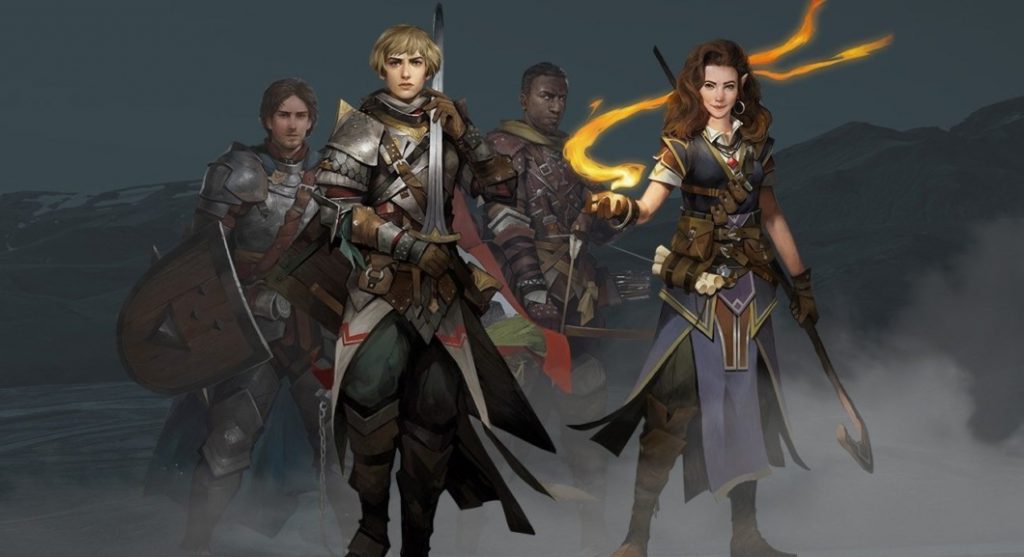
Tabletop role-playing gameplay
1. Introduction
Once you’ve gathered your resolve, found a party, and prepared your character, you’re ready to play. This article explores the inner workings of tabletop roleplaying games.
Let’s remember that RPGs are heavily tied to interpersonal relationships, collective co-creation, and multiple social contracts. Beyond these concepts, in their classic form, they are interactive stories told by a GM (game master), where players, as participants in the story (characters), influence the narrative.
What makes RPGs so versatile is that they can be played in a wide variety of ways: from serious chamber theater productions to wild, fun pub get-togethers. First and foremost, try to get to know the GM’s style, the player requirements, and the specific roleplaying requirements, as well as the rules of the game system. The community has yet to develop uniform rules and ethics; everything depends solely on the GM and the players. Choose carefully, and you’ll enjoy the game more and perhaps even find new friends with similar interests.
2. Duration of games
Duration is an important consideration when planning your leisure time. Whether you want to immerse yourself in a single game for months or take a short trip of one or several sessions, it’s best not to let down your assembled party by unexpectedly quitting.
Short duration (“One-shots”) – designed for a single session, during which everyone briefly gets to know each other or is part of a party. One or more secondary objectives, almost always one major objective per session, which ends when resolved. There’s very little time for character reactions, exploration, and roleplaying. Suitable for beginners, experimentation, and both the GM and players.
Medium – These are the most common games and can offer a variety of participation options for players (from session participation for a single game to an open table, where players come whenever they can and want to play). Most often, this is a regular game where everyone has become accustomed to each other and formed a social circle. Typically, the number of games ranges from 5 to 25. Players have time to experience a variety of experiences and perhaps even develop their character, experience multiple story arcs, and complete several quests.
A long-term game is a rarity; few masters are willing to take on such a complex game, much less implement it fully. The number of games can be unlimited, as long as someone doesn’t want to quit. Players have time to do everything they wanted and planned, and their characters not only develop but also evolve.
3. Gameplay structure
Whenever people gather around a virtual or in-person table, there are numerous nuances and omissions that people typically have to master on their own and exercise their ingenuity. Even when you’ve established the rules, know the system and setting, and are willing to spend hours explaining the nuances of the chosen game world, newcomers often ignore the basic elements of gameplay. Let’s review the fundamentals of RPG gameplay:
Description : The master creates the environment in which the player characters live, their state, and much more.
Application – actions of players in relation to the current situation.
A die roll determines the success of a player’s request or an NPC’s counter-action. It can be successful, neutral, negative, or even critical.
Any RPG consists of these three elements. As you can see, there’s nothing complicated about it at all. The system and the game master take care of everything else, and we’ll get to that later.
Let’s look at the basic activities within the game:
Exploration – all actions aimed at inspection, solving puzzles, riddles, searching for hidden objects, etc. This also includes the GM’s description of the environment.
Communication (“Social”) – direct negotiations, in any form, not necessarily vocal (verbal). Typically the most lively part of all games, it develops the narrative.
A battle (“Combat”) is a combat encounter with an enemy, a party member, or any other player. Depending on the system and the Master’s style, it can take a significant amount of time.
All of this occurs within a certain narrative scale. For better understanding, let’s break it down from macro to micro:
The game is the totality of all the plots, the themes touched upon in the game and their logical completion.
A Story Arc is a series of stories united by a common plotline. Typically, a game contains several, and players follow only one throughout the game.
A story is a series of scenes connected by the general logic of the characters’ behavior, the plot thread, and the desire to solve the problem at hand (no matter in what form).
A scene is a collection of multiple situations in a single, conventional “location,” designed to easily control time intervals, the operation of effects and abilities used, as well as to divide the player’s attention so that everything that happens doesn’t merge into a single background.
A situation is a series of actions connected by the general logic of the world, the actions of players, etc.
A claim-action is a specific action by players that creates and animates the narrative.
Despite the large number of elements, knowing them is not essential to playing. Understanding them for general development will make it much easier to grasp the structure of a session and plan your own and group actions.
4. Player activity
Player activity is what people come to play for. The breadth of your in-game capabilities depends not only on your character, but rather on how flexibly you utilize your available attributes, skills, abilities, and so on, depending on the system. With each new session, you’ll come up with new ideas on what to do and how to best implement them, and don’t hesitate to implement them. The main ones are:
Spotlight refers to any game-related activity. Arguably one of the most valuable resources in the game, it’s typically distributed by the GM. From the very beginning of your first steps in RPGs, it’s important to pay close attention to your activity. Try not to be passive, but to react promptly to emerging situations; this will help you master the game much faster. Don’t forget about other players; they also need spotlights; otherwise, they won’t be able to realize their potential, and your group will become weaker.
Requests – you’re the only one in control of your character most of the time. It’s vitally important to learn to make unambiguous requests that the GM understands in the coming sessions. You’ll be disappointed when your character does something completely different than you wanted, at best making a fool of themselves, and at worst, putting them on the brink of death. We’ll discuss requests in more detail below.
Any intelligent creature encountered in the game can be a potential conversational partner, carrying a wealth of information. Whether a townsperson, a peasant from the fields, or a captured bandit, they can all reveal the history of the area, the region, the events in the city, and much more.
Another aspect of communication is the opportunity to role-play your character. NPCs always react to your actions, and you see them through them like a mirror. If you succeed, try to gradually reveal your character with each subsequent action, through small habits, attitudes, expressions of emotion, and anything else that comes to mind (within the context of the character, of course).
Participating in combat —this will likely happen sooner or later, so don’t get flustered and prepare in advance. You need to learn all your character’s abilities. Starting as a beginner, imagine the situation you’re in and describe your actions clearly. The GM will adapt them to the game’s system and prompt you to roll the dice.
The next step is to explore your abilities and then delve deeper into the system, starting with how characters move and what actions they can take in the game world.
Intra-group communication and conflicts – don’t be afraid to ask other characters about anything within the game. Try to find out their attitudes toward current events, their opinions on things; this helps bring other characters to life, lifting them out of the shadows of the narrative. By communicating, you further enliven your story, relieving the GM of their burden and allowing them to better prepare the next scene. During communication, differences in perspective, worldviews, life experiences, specific situations, and much more will inevitably arise. Such situations further enliven the game, revealing completely new sides of the characters; they are forced to step out of their comfort zones and defend their position. This may lead to direct confrontation, but that’s part of the story, so try to avoid it.
5. List of tips on how to improve your application
– Hasty actions (unless they are roleplaying) are usually the worst possible ones;
– When playing in a group, do not try to do everything for others, leave them the opportunity to help you and take on the activity for which their character is prepared;
– Imagine the situation you are in, if the master gives a poor description, try to add small insignificant details to expand your application and use them as an advantage;
– The request must be unambiguous, precise, and concise. Using a complex structure, you risk being misunderstood by the technician;
– Learn to make a comprehensive statement, describing not only the action itself but also how you execute it. For example, you might attack an enemy or carefully attack an enemy after making a distracting move, positioning your sword to block a blow aimed at you as it approaches;
– Try to get used to the character as quickly as possible and act on their behalf; then it will be much easier for you to stay within the logic of the world. The GM is more receptive to such requests, as they are already attuned to the game world;
– Good applications inspire other players, and sooner or later they will start trying to do the same in order to improve the overall game and the effectiveness of the party.
6. Working with the master
Even experienced players often neglect this point, leaving everything to the GM. Much of the game depends on the GM. By engaging with them early on, correcting your perspective in a given situation, you create a richer and more vibrant story. With each clarification and information learned about the world, perhaps even about your character, you become more immersed in the world, better understand what’s happening, and can fully participate. Another important aspect of close cooperation with the GM is that it allows you to develop a trusting relationship and get to know each other better, moving from a passive observer to an active participant in the narrative. Subsequently, the GM will give you more opportunities to participate in the story.
Let’s touch on each point briefly:
Preparatory (pre-game) – try to find out as much as possible about the GM’s requirements and wishes. Talk about what you personally want to get out of the game and in what form.
Character Generation – Create your character based on the previous step. Discuss it with your GM to determine how it fits the game, the events of the campaign, the potential party, and other nuances. Try to ensure your GM understands your character as well as possible.
During the game —when the GM isn’t busy, there’s a pause or break, or you need a quick clarification during the game—ask and try to learn as much as you can about the situation your character and the group are in if you’re missing something or misunderstanding something. There are no stupid questions, only stupid actions taken due to a misunderstanding of the situation.
Feedback is an important component. You evaluate the current session and compare it to previous ones. You politely point out mistakes, shortcomings, and anything you don’t like. This is crucial if you want to adjust yourself and the master during the game, remove any interfering elements within the game, and continue in a more comfortable environment.
Outside of the game is the most challenging aspect. If the GM is open to questions after the game, then take your time formulating precise, unambiguous questions to uncover elements of the lore, the attitudes of certain NPCs, the state of affairs in the city, and much more. For example, perhaps you, as a Druid, need to learn about your traditions and cultural aspects for greater immersion and roleplaying during the game itself. Don’t forget that gameplay elements can also take place outside of the game session.
7. Conclusion
This article covers the basic elements of any RPG game. They can vary greatly and have their own conventions, requiring adaptation and a special approach. If you’re having trouble, consult with a game master or more experienced players and try to improve the situation.
Search, try, and don’t be afraid to abandon the game, the GM, or the players (if you’ve chosen the thorny path of becoming a GM). RPGs are gaining momentum and popularity, so you won’t have to stick to just one community. Try to find a GM who meets your needs. Don’t give up on this hobby; if you have a bad experience, it’s likely you simply weren’t compatible in terms of interests, your views on the game, the setting, or the character didn’t align.
Good value on the cubes!